
President William Ruto’s decision to remove police officers from the management of national examinations marks a sharp break from years of heavy security oversight that turned schools into high-security zones during exam seasons.
Announcing the policy shift on January 23, 2026, the President said the country must rethink how it treats learners during assessments.
“Exams are part of learning. They must not be a life-and-death issue,” Ruto said, adding that examinations should never be handled like security emergencies.
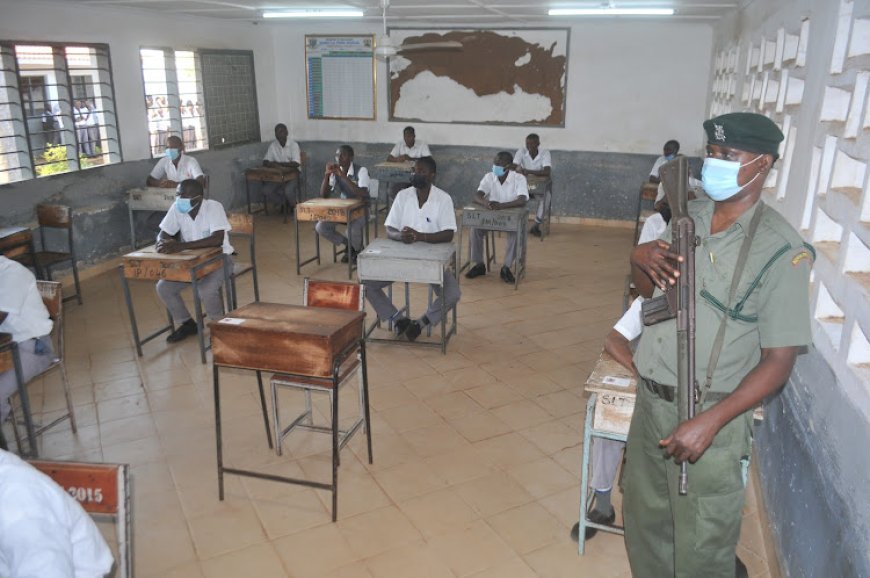
For years, armed police officers were deployed inside exam rooms and school compounds across the country. According to the President, that approach created fear, anxiety and unnecessary pressure on learners.
“We have removed the police from managing exams because examinations are part of the learning process and should not be handled as a security operation,” he said.
Ruto said the move is part of broader education reforms under the Competency-Based Curriculum (CBC), which shifts emphasis from single, high-stakes exams to continuous assessment and holistic development.
How Exam Security Is Being Handled Now
With police officers withdrawn from exam rooms, security is now being enforced through technology and logistics rather than physical presence.
The Kenya National Examinations Council (KNEC) has rolled out smart digital padlocks on exam storage containers, creating electronic audit trails that show when containers are opened and by whom. This reduces human interference and opportunities for exam leakage.
Exam papers are also personalised, printed with each candidate’s name and index number to prevent impersonation and fraud.
Under the new arrangement, police officers are still involved, but in a limited capacity. Their role is restricted to transporting examination materials and guarding storage containers, with zero officers stationed inside assessment rooms.
President Ruto said the new approach restores professionalism and trust in educators.
“If we trust our teachers to teach, then we must trust them to supervise exams,” he said, insisting that policing learners sends the wrong message about education.
Heavy Deployment and Rising Costs
In previous years, exam periods triggered massive police deployments across the country.
Between 60,000 and 70,000 police officers were deployed annually to oversee national examinations, with at least two armed officers stationed at most centres. In 2023, exams involved approximately 2.5 million candidates, all under intense security supervision.
For the 2025/2026 examination cycle, which includes KCSE, KPSEA and KJSEA, the number of candidates rose to 3,424,836, yet police deployment dropped sharply to 22,247 officers, strictly for logistical support.
The heavy police presence also carried significant financial costs. Allowances for tens of thousands of officers placed pressure on the Treasury, often leading to delays in payment and complaints within the service.
The Cost Shift and a Turning Point
Parliament allocated KSh 5.9 billion to support the 2025/2026 national examinations, with the total cost of running the exam cycle estimated at about KSh 12 billion.
Officials say scaling back police involvement will allow funds to be redirected to school capitation and learning materials, rather than security allowances.
Even with reduced exam duties, police funding remains unaffected. The National Police Service received KSh 125.7 billion in the 2025/2026 budget to focus on broader internal security needs.
President Ruto described the move as historic.
“2026 will be the year that future generations will look back on and say, ‘That is when Kenya changed course,’” he said.
The government maintains that removing police from exam management is not about weakening security, but about restoring dignity to learning and easing pressure on millions of Kenyan learners.


