
As Nairobi’s traffic continues to swell, the Gitaru Interchange is emerging as a major intervention along the Kikuyu corridor.
The project, which will connect the Nairobi–Nakuru Highway with both the Southern and Western Bypasses, is now approaching completion and is expected to significantly ease congestion at one of the capital’s busiest junctions.
For years, the Gitaru section has been a notorious bottleneck for motorists travelling between Nairobi, Central Kenya and the Rift Valley.
Once operational, the interchange is expected to streamline movement across the region, reducing travel times and improving efficiency for commuters and freight transport.
Officials say the project had initially stalled due to financial constraints before a new financing approach allowed construction to resume.
According to Kenya National Highways Authority Director General Eng. Luka Kimeli, the government adopted securitisation to unlock funding and restart several stalled projects.
“The Gitaru Interchange had stalled due to funding constraints, but securitisation enabled us to resume this critical project, which was initiated in the year 2024,” Kimeli explained, noting that the government is pushing ahead with road projects regardless of when they began. “Government is perpetual, and leaving unfinished projects from previous administrations punishes Kenyans.”
Beyond its scale, the design of the interchange also carries an unusual inspiration. Kimeli notes that the four-loop cloverleaf design mirrors a small, common plant familiar across many Kenyan communities.
“One fun fact about the Gitaru interchange is the distinctive design inspired by a small, common plant that you all know, the four-loop cloverleaf, often regarded as a weed and known by different names across Kenyan languages and Sheng,” he said.
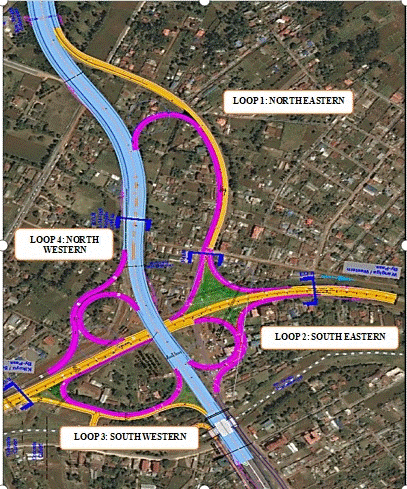
The design is intended to allow vehicles to move continuously between connecting highways, eliminating the need for traffic signals and significantly reducing congestion.
Once complete, the interchange will allow smoother traffic flow while shortening travel times for thousands of motorists who pass through the corridor daily.
Construction of the project has also generated jobs. According to Kimeli, the works have already employed more than 1,100 people, with the project now about 85 per cent complete and scheduled for completion by December 31, 2026.
For residents of Gitaru, the transformation is already visible.
Apostle Paul Mosoti, who lives in Gitaru but works in nearby Kikuyu, says the project is beginning to ease movement along the busy route.
“I am a resident of Gitaru, but I work in Kikuyu. This road helps a lot in transportation,” he said, adding that the project has long been awaited by the community.
Older residents recall when the area was sparsely developed, with Mosoti describing how locals once referred to Gitaru as “like a bush.” Today, the construction activity signals a shift that many believe will unlock new economic opportunities.
According to Mosoti, who also operates a security business connecting Kikuyu and Kisii, improved road networks translate directly into economic growth.
“This is the biggest roundabout in Kenya; there is no other project like this one in Kenya. It connects Ruaka, Kisii, and Nairobi… where there is a good road, you find all manner of people (good and bad), and that is where we come in (security), and we get jobs,” he said.
Beyond local benefits, the interchange forms part of the wider A104 highway rehabilitation programme aimed at improving the efficiency of the Northern Corridor.
Reduced congestion at Gitaru is expected to lower fuel consumption, improve road safety and enhance logistics for regional trade.
Innovative financing measures have played a role in reviving stalled road works across the country. When President William Ruto’s administration took office, it inherited Ksh175 billion in pending bills owed to hundreds of contractors, some dating back nearly a decade.
In April 2025, the Cabinet approved a securitisation model allowing the Kenya Roads Board to raise funds by leveraging predictable revenues from the Road Maintenance Levy Fund, a move that helped accelerate projects like the Gitaru Interchange.
As construction moves toward completion, residents and businesses along the corridor are already anticipating the economic ripple effects.
“This road project has helped a lot,” Mosoti said, pointing to easier movement and the opportunities that improved infrastructure is expected to bring.

