
The Government led by President William Samoei Ruto has unveiled plans for the Kenyatta Avenue Viaduct, a major urban infrastructure project intended to modernise traffic movement through the heart of Nairobi’s Central Business District (CBD).
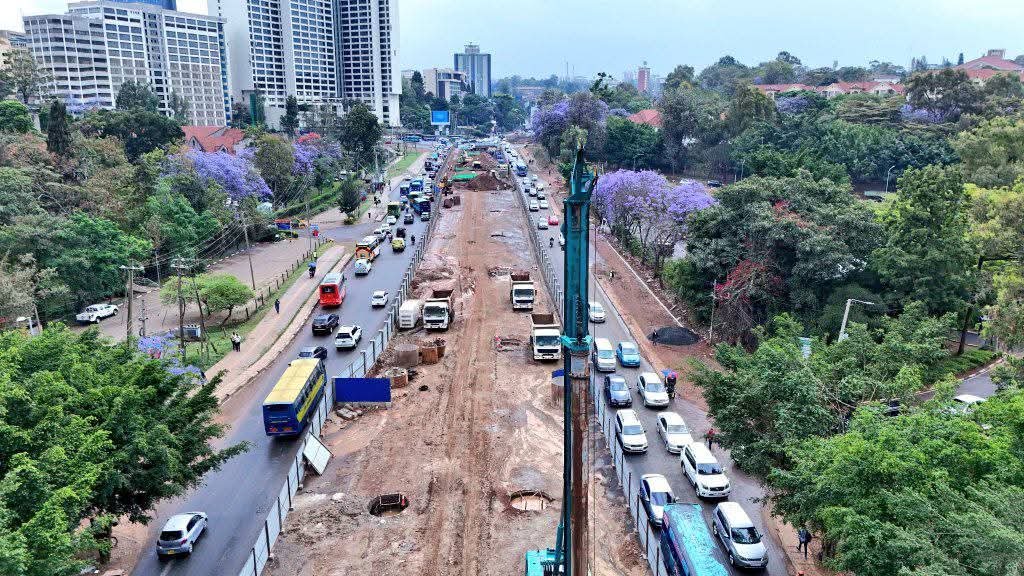
The elevated roadway designed to carry uninterrupted through-traffic above gridlocked junctions is expected to reduce commute times, improve road safety and support economic productivity in the capital.
“This project will ease congestion, shorten travel times and enhance road safety by separating fast-moving traffic from local and pedestrian movement,” President Ruto said on Thursday, underscoring the Government’s commitment to sustainable urban transport solutions.
Elevated corridor to decongest the CBD
Urban planners and transport officials describe the viaduct as a “game-changer” for motorists and businesses that navigate the often congested Kenyatta Avenue corridor daily.
By elevating through-traffic above surface intersections and pedestrian crossings, the structure is designed to reduce delays caused by frequent stops, traffic lights and mixed street-level activity.
“The objective is to allow vehicles that are just passing through the city to move swiftly, without being held up by local junctions or heavy pedestrian flow,” President Ruto said. “By doing so, we reduce time wasted on the roads and boost overall efficiency.”
Officials say the design will integrate with existing major roads feeding into the CBD, creating a smoother traffic flow for both long-distance travel and intra-city commutes.
A step towards safer streets
In outlining the rationale for the project, the President emphasised the viaduct’s role in improving safety for all road users.
“Separating high-speed through traffic from local traffic, public transport and pedestrians will significantly reduce the risk of accidents,” he stated, highlighting the need to protect vulnerable road users while accommodating Nairobi’s growing vehicle numbers.
Transport experts say that grade separation — which elevates one stream of traffic above another — is common in major global cities seeking to balance accessibility with safety and movement efficiency.
Economic productivity and urban growth
Beyond addressing congestion, officials link the viaduct to broader economic goals.
Heavy traffic is widely seen as a constraint on productivity in Nairobi. Delays contribute to increased fuel costs, lost working hours and inefficiencies in the movement of goods and services.
“We recognise that traffic delays cost businesses money and workers time,” President Ruto said. “By improving mobility, we enhance productivity and competitiveness.”
City planners and business groups have also welcomed the announcement, describing the project as a critical investment in the future of the capital’s transport network.
Part of a broader transport strategy
The Kenyatta Avenue Viaduct forms part of a wider urban mobility agenda aimed at modernising Nairobi’s roads alongside expansions, junction upgrades and enhancements to public and non-motorised transport infrastructure.
Deputy President Kithure Kindiki has previously emphasised the need for integrated solutions to Nairobi’s traffic challenges, stating that infrastructure development must be forward-looking and responsive to rapid urban growth.
“If we want a city that’s fit for the 21st century, we must invest in solutions that cater to increased travel demand while protecting safety and sustainability,” he said in a recent national briefing.
As the project moves from planning toward implementation, Nairobi residents and commuters will be watching closely — hopeful that the viaduct will deliver on its promise of smoother traffic, shorter travel times and a smarter, more efficient city.

