
Rural areas across Kenya have been mostly served by dusty and muddy roads, which complicate the mobility of both products and people.
This is a result of years of heavier spending on urban roads and building highways to connect key towns and infrastructure, at the expense of grassroots areas, where most production takes place.
But that could quickly change under the Kenya Kwanza government.
After nearly two years of cautious footwork, President William Ruto’s administration is now in full stride on road construction. Not just any roads, but the unglamorous, dusty, and often overlooked lifelines that connect Kenya’s rural heartlands to markets, cities, and opportunities.
“We had many road projects that we started before 2021 but stalled because of lack of money. Last year we said we needed to sort the economic mess,” he said.
Ruto revealed that the county’s economy is now stable after spending nearly 20 months reconstructing the government.
“All the roads that stalled like the Mau Mau Road and many others here in Naruku,” Ruto said while addressing residents of Nakuru County.
Dubbed the Last Mile Roads Plan, this ambitious project focuses squarely on feeder and rural roads — the economic arteries of farmers, traders, small manufacturers, and job-hungry youth.
At its heart, the plan aims to build or upgrade over 10,000 kilometres of roads across the country by 2027, a dramatic escalation of activity after a long stall following the 2022 elections.
These aren’t just highways that make headlines; they are farm-to-market roads, intra-county links, industrial access routes — the kind of infrastructure that turns dormant potential into real production.
For months, critics accused Kenya Kwanza of dithering on roads while inflation rose and public impatience mounted. But behind the scenes, the delays were not from indifference but from hard math.
The Ruto administration says it inherited a liquidity crunch and a portfolio of stalled road projects riddled with debt and contractor claims.
“We didn’t have money to direct towards roads but now things are looking good, we are back on the roads agenda,” said Deputy President Kithure Kindiki.
This followed the introduction of securitisation — a new financing model using projected fuel levy collections to raise upfront capital — that allows the government to revive construction without sinking deeper into unsustainable borrowing. The result: a quiet but accelerating boom in rural infrastructure, now backed by local capital markets and ring-fenced funds.
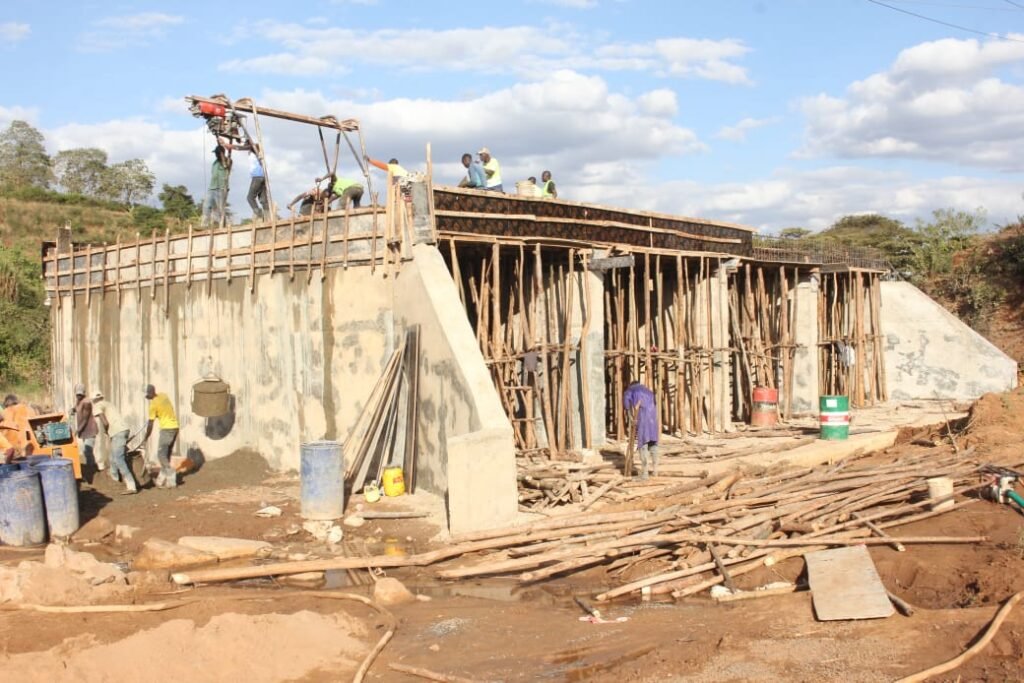
Why rural roads? Because this is where Kenya’s real economy lives, according to the Kenya Kwanza manifesto.
Agriculture employs over 70 per cent of the rural population, yet poor access to markets, inputs, and aggregation centres have kept farmers in subsistence cycles.
In counties like Bungoma, Meru, and Kitui, new roads will cut transport costs by up to 40 per cent, connecting maize and avocado farmers to collection points and processors.
In Turkana and West Pokot, feeder roads will open livestock markets and slash travel times for veterinary services and feed supply.
Small traders in places like Mbeere and Taita Taveta, who once spent a third of their income on boda boda rides over impassable roads, now speak of reaching new customers and restocking more frequently.
The roads revival isn’t just reshaping the landscape; it’s reigniting dormant sectors. Cement consumption, according to Kenya Bureau of Statistics data, has surged by 20.3 per cent in the first quarter of 2025, while steel and iron consumption — a key input in culverts, bridges, and reinforcements — is up from 230,785 tonnes to 313,289 tonnes year on year. Companies like Bamburi and Devki are ramping up output, and local steel fabricators are adding shifts to meet demand.
“As the payments of road contractors happen, then also the manufacturers would also get paid, and then they are able to produce more,” said Kenya Association of Manufacturers (KAM).
“Last year, orders had almost dried up. Now we’re working weekends again,” says David Mwangi, a steel supplier in Thika.
This uptick in construction demand is trickling down into jobs.
According to the Ministry of Roads, over 48,000 construction-related jobs have been created directly through projects currently underway, with tens of thousands more in transport, supply, and service chains.
At a project site in Kirinyaga County, 26-year-old Mary Wanjiru, a casual worker and single mother, mixes gravel under the sun. “It’s hard work, but it’s feeding my son and paying rent. Before this, I had nothing.”
In Kisii, boda boda operator Evans Nyabuto says the freshly graded road linking Nyamache to the main highway has doubled his daily trips. “People move more now — I earn more. Even shops are opening near the road.”
And for 62-year-old Mzee John Kimeu, a tomato farmer in Makueni, the new road to Emali has halved his transport costs and cut post-harvest losses. “Before, the truck would get stuck. Now I send my harvest early and fresh. I’m planting more next season.”
Kenya’s rural economy has long been undervalued, but infrastructure — especially reliable roads — could be the missing link for a low-cost industrial surge. Aggregation hubs, cold storage facilities, and light manufacturing plants are only viable when roads bring down transport costs and guarantee market access.
The government plans to complement road construction withcounty aggregation and light industrial parks across counties. The logic is simple: roads first, then production zones. As transport becomes reliable, investment follows.
The shift is already visible in areas like Naivasha and Eldoret, where new roads are driving interest in logistics hubs, milk processing, and fruit canning.
Politics of visibility
There is also a strong political undercurrent. For Ruto, a self-styled “hustler” president, feeder roads are not just infrastructure — they are messaging.
In his bottom-up economic model, connecting the furthest-flung farmer is a statement of intent.
Unlike grand Nairobi expressways, these roads don’t make flashy headlines, but they do something more important: they make the government felt. In neglected corners, they represent fairness, investment, and inclusion.
Of course, challenges remain. Corruption, poor maintenance culture, and bureaucratic procurement still threaten project timelines. And the durability of new roads, particularly those in high-rainfall zones, will be a critical test of both quality and intent.
But if the current momentum holds, the Last Mile Roads Plan could prove transformative — not just by paving roads, but by paving a new economic path for Kenya’s majority.


