

Kenya is courting international coffee buyers and seeking to triple production, but Agriculture Cabinet Secretary Mutahi Kagwe has put a practical question at the centre of that ambition: does growing coffee pay well enough for farmers to keep investing in it?
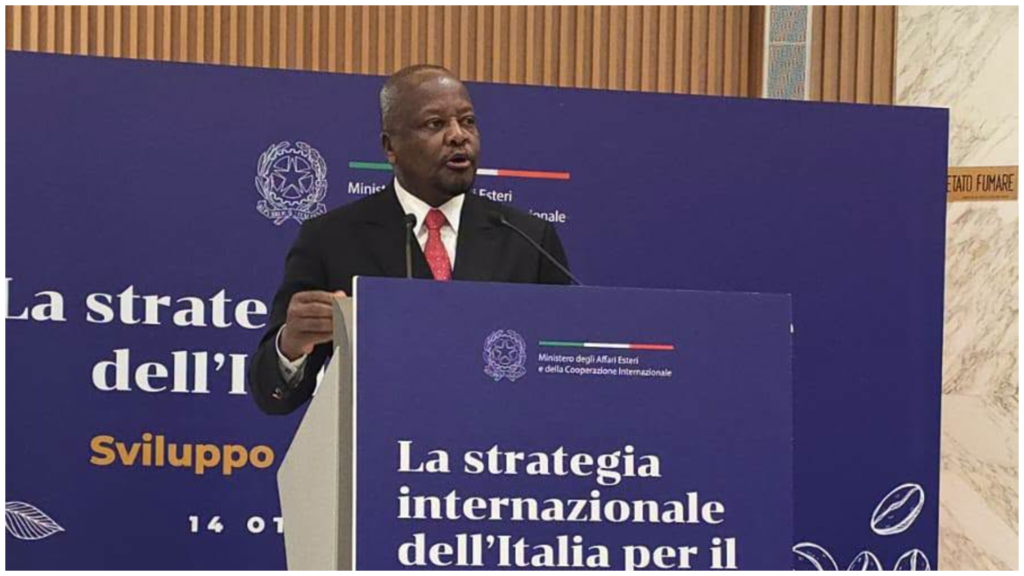
Speaking at Italy’s International Coffee Strategy Forum on October 14, Kagwe urged consuming countries and international coffee companies to treat farmer prosperity as essential to the industry’s future.
His argument connects Kenya’s export ambitions with the decisions made on individual farms. A grower needs money for fertiliser, labour and disease control long before the coffee reaches an overseas buyer.
The scale of Kenya’s coffee comeback
The government is targeting annual production of 150,000 metric tonnes by 2028, from a current average of about 50,000 tonnes, according to an October 9 report by the Kenya News Agency. That requires an additional 100,000 tonnes a year—a 200 per cent increase from the stated baseline.
For comparison, the Kenya National Bureau of Statistics’ 2025 Economic Survey recorded production of approximately 49,500 tonnes for the crop year under review. That is a historical figure, rather than a measurement of the current harvest.
Kenya’s decline has unfolded over decades. A June 2025 analysis by the Kenya Institute for Public Policy Research and Analysis (KIPPRA) cited output of about 130,000 tonnes in 1988.
Kagwe’s statement used a higher historical comparison of approximately 150,000 tonnes, without identifying the year. The figures establish the broad scale of the challenge, but should not be treated as an identical statistical series.
Why better prices must reach the farm
KIPPRA identifies financing constraints, inefficient cooperatives, outdated farming practices and climate pressures among the obstacles to recovery.
Its analysis also links cooperative financial irregularities to delayed payments and weaker farmer confidence. These problems matter because farmers need both a worthwhile price and access to money when farm work is due.
There is evidence of how improved returns can support production.
In its May 2025 Coffee Annual report, the US Department of Agriculture’s Nairobi office forecast that Kenya’s 2025/26 output would rise by 13.3 per cent to 850,000 bags of 60 kilogrammes each—equivalent to 51,000 tonnes.
The forecast partly reflected an expectation that higher prices would enable farmers to apply more fertiliser and improve pest and disease control. It also included the influence of coffee’s production cycle. It was a forecast, rather than a confirmed harvest result.
The implication is straightforward: better earnings can help finance the next crop.
For the revival programme, the useful measures will therefore include yields, production costs, deductions and payment times, alongside the price obtained when coffee is sold.
What the Italian market can change
TopNews previously reported on a premium green coffee shipment to Italy’s Port of Trieste, presented by officials as an opportunity to expand market access and improve producer returns.
Such initiatives can broaden commercial relationships. Their effect on farmers, however, depends on the terms of sale, the costs incurred and how much of the proceeds reaches producers.
Green coffee also differs from a finished retail product: it still requires roasting before it reaches the consumer.
Kagwe’s latest intervention brings these issues together. He called for investment in the Kenya Coffee brand and challenged international companies to support the producers on whom their businesses depend.
Italy’s foreign ministry confirmed that the October 14 meeting brought together Kagwe, international organisations and industry leaders, including representatives of Lavazza and Illycaffè.
Its coffee strategy combines UNIDO’s ACT Coffee initiative with a separate investment initiative developed with the World Bank Group and Italy’s Cassa Depositi e Prestiti.
Those partnerships provide routes for technical support and investment. The meeting itself does not establish that new funding has already reached Kenyan farmers.
From research to roasting skills
Kenya’s institutional reforms also form part of the recovery effort.

The Coffee Act, 2026 provides for the Coffee Board of Kenya and the Coffee Research and Training Institute, strengthening the framework for sector regulation and research.
Alongside these reforms, UNIDO says its ACT programme supports a national Coffee Training Centre in Ruiru, developed in partnership with the research and training institute.
The centre is intended to support skills such as roasting, coffee tasting and barista work, as well as collaboration between businesses and public institutions.
These are distinct parts of the coffee economy. Research can help improve farm productivity; processing and service skills can help businesses develop products and earn income further along the supply chain.
Neither automatically guarantees a higher farm payment. The connection must be built through viable businesses and purchasing arrangements that reward growers.
What would show the revival is working?
Our earlier coverage of the government’s coffee revival programme set out the ambition to improve farmer earnings.
The next test is measurable progress: more productive trees, manageable costs, transparent deductions and reliable payments.
Kagwe’s appeal gives the government’s production drive a clear economic foundation. Farmers who can earn and reinvest have a stronger reason to maintain their coffee and expand production.
Kenya’s route towards 150,000 tonnes therefore runs through the farm account as much as the export market.


