Principal Secretary Raymond Omollo has outlined sweeping reforms across Kenya’s security sector, describing them as a transformative effort to modernise institutions, improve officer welfare, and enhance service delivery.
Speaking on the ongoing changes, Omollo said the reforms affecting the National Police Service (NPS), Kenya Prisons Service (KPS), and National Youth Service (NYS) represent a deliberate policy shift by the government.
“The ongoing reforms in the National Police Service (NPS), the Kenya Prisons Service (KPS), and the National Youth Service (NYS) mark a deliberate shift to strengthen capacity, improve welfare and modernize our security sector,” he said.
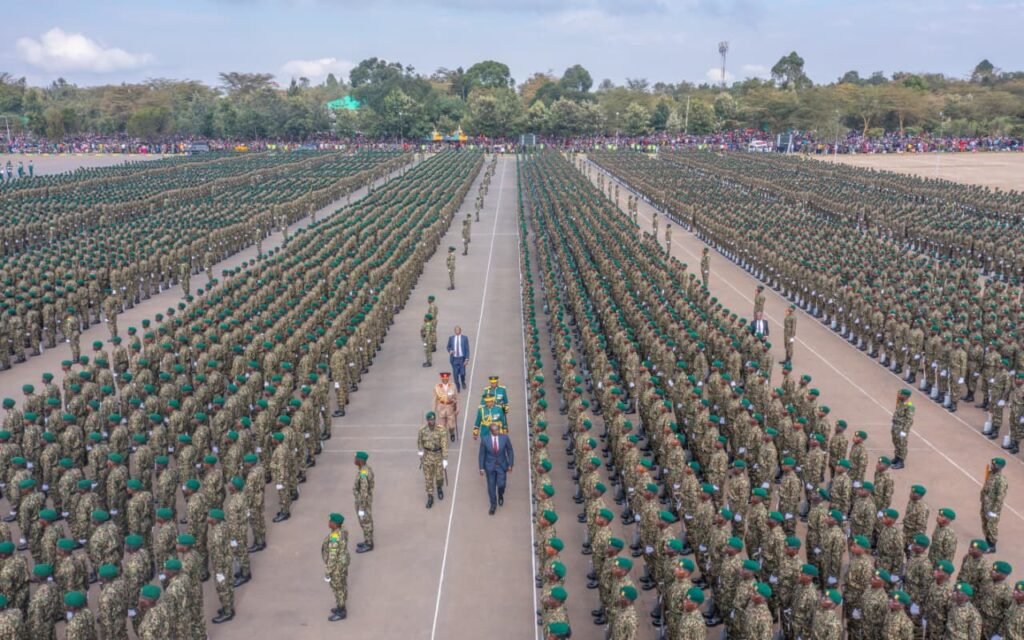
Newly recruited police officers during a national training exercise aimed at boosting security capacity.
Recruitment drive to bridge security gaps
A key pillar of the reforms has been the large-scale recruitment of officers aimed at addressing personnel shortages and improving national security coverage.
According to Omollo, a total of 13,860 officers have been recruited so far, including 10,000 Police Constables and 3,860 Prison Constables.
“So far, 13,860 new officers have been recruited; 10,000 Police Constables and 3,860 Prison Constables, helping to address past gaps, reduce workload and enhance security presence across the country,” he stated.
The recruitment drive is expected to ease operational pressure on existing officers while strengthening the country’s ability to respond to security challenges.
National Youth Service cadets during a parade reflecting ongoing institutional transformation. Photo/Courtesy
Historic salary review and welfare reforms
The government has also implemented what Omollo described as the most extensive salary review in the history of disciplined services, significantly boosting officer earnings.
“At the same time, the Government has implemented the most extensive salary review in the history of the disciplined services, with increases of up to 40% over two years,” he said.
He confirmed that the first two phases of the salary increment have already been completed, with the final phase scheduled for July 2026.
“Phases I and II are complete, with the final phase due in July 2026, significantly improving earnings and making the services more competitive,” Omollo added.
Beyond salaries, the reforms have introduced enhanced welfare measures, including improved allowances and expanded housing programmes.
“Welfare reforms also include enhanced risk and hardship allowances, an ongoing housing programme that has delivered about 5,000 units towards a target of 28,000,” he noted.
The transition to the Social Health Authority (SHA) is also expected to provide broader and more comprehensive medical cover for officers.
Modernisation and accountability push
Omollo further highlighted ongoing legislative and operational reforms designed to improve accountability and efficiency within the security sector.
“In addition, key legislative reforms are underway to strengthen accountability, professionalism and operational efficiency, alongside continued investment in modern equipment, communication systems and digitization of services,” he said.
These changes include the adoption of new technologies, upgraded communication systems, and digitised processes aimed at improving coordination and service delivery.
Building a people-centred security service
According to the PS, the combined impact of recruitment, better pay, improved welfare, and modernisation is shaping a more responsive and effective security system.
“These measures are building a more efficient, well-equipped and people-centered security service,” Omollo emphasised.
The reforms come at a time when Kenya is seeking to strengthen internal security while also improving the working conditions of officers, a move seen as critical in boosting morale and professionalism across the services.
Sifuna’s 2027 political vehicle was registered in 2022. Its own records reveal the leaders and principles behind The Equitable Party before his takeover.