
A hanging train — a suspended or “upside-down” monorail with carriages hung beneath a single elevated beam — would offer a different answer to Nairobi’s chronic congestion than more high-capacity road building.
Suspended systems are fully grade-separated, require a narrow linear footprint of piers and a single beam, and can thread above rivers, narrow streets and existing rights-of-way with limited land acquisition. That reduces displacement, utility relocation and long construction corridors compared with widening or building new expressways.

Following President William Ruto’s announcement of an expressway from Thika to the National Museum, a Kenyan proposed an integrated concept: build a hanging train directly beneath the expressway rather than as a competing mode. This approach reframes the highway as a dual-use mobility spine. The expressway would serve long-distance and interurban motorists, while the suspended train beneath it would carry high volumes of daily commuters quickly and predictably between Thika, Githurai, Roysambu, Pangani and the Museum Hill precinct.
Integrating the two solves multiple urban transport challenges simultaneously. First, it avoids acquiring additional land for a stand-alone rail corridor. Second, it uses the expressway’s pillars as structural hosts for the suspended guideway, reducing construction redundancies and lowering urban disruption. Third, because the train is entirely off the road grid, it eliminates signal delays, reduces travel times, and provides a dependable alternative for thousands who would otherwise rely on matatus or private cars.
Cost implications are material. An elevated expressway in Kenya typically ranges between US$18–21 million per kilometre. Adding an under-hung rail system could raise total per-kilometre costs significantly, with global suspended or monorail systems often costing several multiples of road construction. However, the value proposition is capacity: a hanging train can move far more people per hour than any lane of motorway, reducing long-term pressure for additional road expansion.
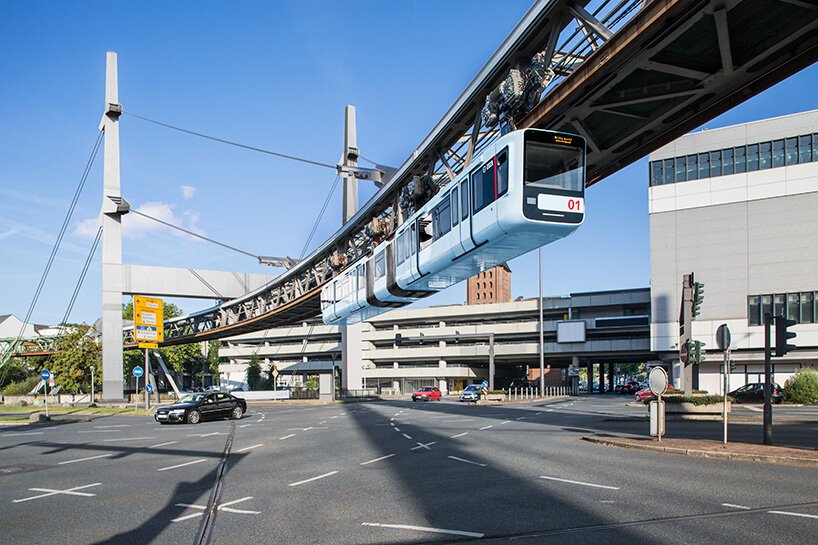
International examples underscore this transformation. Wuppertal’s Schwebebahn in Germany has operated for over a century, reshaping commuter flows and anchoring dense urban development along its corridor. Modern elevated systems in Asia have similarly supported modal shift, reduced congestion, and expanded the reach of metropolitan labour markets.
By combining expressway and suspended rail in one corridor, Kenya would not choose between cars and mass transit. Instead, it would create a unified, space-efficient, long-horizon mobility investment that addresses congestion, access, and urban growth in a single, coherent corridor.


