


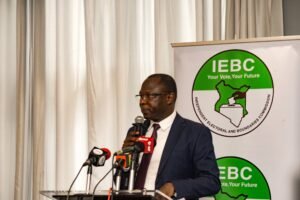
Kenyan voters will not be allowed to take photographs of marked ballot papers during elections, with the Independent Electoral and Boundaries Commission (IEBC) warning that the restriction is intended to protect the secrecy of the vote.
IEBC Commissioner Dr Ann Nderitu explained that voters cannot photograph their marked ballot papers while casting their votes or during the counting process because Kenya’s electoral system is based on the principle of a secret ballot.
Nderitu said the restriction is specifically aimed at preventing images that could reveal how an individual voter cast their ballot.
“The only thing that you cannot take a photo of is the photo of the ballot paper when someone is voting, and even when you are counting, because the elections, according to the Constitution of Kenya, are by secret ballot,” Nderitu said.
She, however, clarified that the restriction does not apply to election results forms after results have been announced and the documents have been completed.
Why ballot paper photos are prohibited
The prohibition on photographing marked ballot papers is intended to ensure that voters can make their choices freely and confidentially without fear of their vote being traced or used to prove how they voted.
The distinction is important because political party and candidate agents are allowed to document declared results using the relevant election forms. They are not, however, permitted to photograph individual marked ballot papers in a manner that could expose a voter’s choice.
Kenya’s electoral laws require election officials, candidates and agents to maintain the secrecy of the ballot. The law also prohibits attempts to obtain information about the candidate for whom a person is about to vote or has already voted.
Capturing an image of a marked ballot for financial gain or to demonstrate allegiance is also an offence under the law. A person convicted of the offence may face a fine of up to KSh1 million, imprisonment for up to three years, or both.
The rules are designed to guard against practices such as vote-buying, coercion and intimidation. A voter could, for example, be pressured to photograph a marked ballot as proof that they supported a particular candidate.
IEBC has previously emphasised that voting must take place secretly inside the polling compartment. After marking the ballot, the voter is required to fold it in a manner that conceals the choice before placing it in the ballot box.
What can be photographed at polling stations?
While marked ballot papers are protected by strict secrecy rules, Nderitu said agents can photograph the relevant results forms once votes have been counted, results announced and the forms completed.
“When it comes to the counting of votes, we allow the agents to take a photo of the form once the results have been announced and the forms have been filled,” she said.
This means that election stakeholders can document officially declared results without compromising the confidentiality of individual voters.
The distinction also helps observers and political parties maintain records of results while ensuring that the ballot itself remains secret.
Police to operate under IEBC during elections
Nderitu also explained the role of police officers deployed to polling stations and tallying centres during elections.
She said police officers assigned to electoral locations operate as electoral officials under the IEBC during the election period and are placed under the command of the relevant returning officer.
“Police officers who are sent to polling stations and tallying centres are electoral officials, those are usually under the IEBC during an election. They are usually under the command of the returning officer of that election,” Nderitu said.
She added that officers are trained and briefed before deployment to ensure they understand electoral procedures and their responsibilities during the polls.
“When we are dealing with polling stations, we train the police officers and brief them as electoral officials,” she said.
The arrangement is intended to ensure that security personnel understand their role in supporting the electoral process while following instructions issued by election officials.
IEBC steps up preparations for 2027 polls
Nderitu said the commission’s early communication about election preparations is aimed at ensuring Kenyans understand what to expect ahead of the 2027 General Election.
She described the approach as both a legal and administrative measure intended to ensure the country is adequately prepared for the next election.
“It is good practice, legally and administratively, to make sure that the country is well aligned towards the next general election,” she said.
The commissioner added that keeping the public informed is part of IEBC’s communication strategy.
“It is also part of our communication strategy to allow Kenyans to know what is happening and what to expect as we go along,” Nderitu said.
The commission has already started preparations for the August 10, 2027 General Election, including voter registration, electoral planning and engagement with stakeholders.
As preparations continue, IEBC is expected to maintain emphasis on ballot secrecy, reminding voters and other electoral stakeholders to follow procedures designed to protect the confidentiality and integrity of every vote.


 warning that the restriction is intended to protect the secrecy of the vote.)