
Kiharu MP Ndindi Nyoro has launched an ambitious education support initiative that promises to significantly lower the cost of secondary schooling while improving learning conditions for thousands of students in his constituency.
The move is likely to reinforce his reputation as one of Kenya’s most policy-focused legislators.
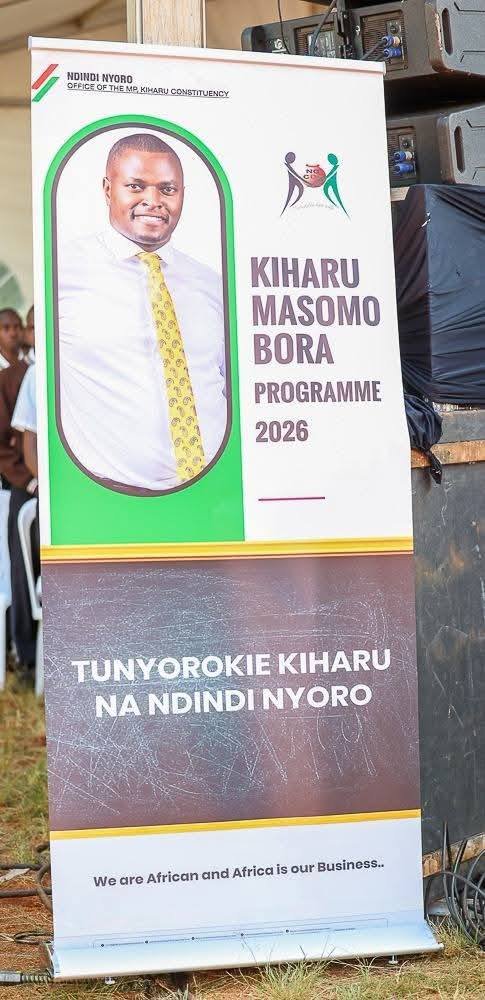
The programme, branded Kiharu Masomo Bora, was formally unveiled ahead of the 2026 academic year and targets all 65 public day secondary schools in Kiharu. From term one next year, learners enrolled in these institutions will pay a uniform fee of just Ksh 500 per term, a drastic reduction that local education officials say could ease pressure on households struggling with rising living costs.
Speaking at the launch, Nyoro framed the initiative as a practical intervention aimed at keeping children in school and improving outcomes, rather than a symbolic political gesture. He said affordability, nutrition and infrastructure had emerged as the biggest barriers to learning in Kiharu, particularly for families dependent on small-scale farming and informal work.

FREE LUNCH
Beyond subsidised fees, the programme introduces a comprehensive school feeding component. All learners in participating schools will receive lunch from Monday to Saturday, a measure educators say could improve attendance and concentration, especially in the afternoons.
In a detail that has already captured public attention, Nyoro announced that chapati will be served every last Friday of the month, turning what he described as a “small joy” into a standing tradition across Kiharu’s schools.
More than 12,000 learners are expected to benefit directly from the programme in its first year. Importantly, the scheme is not restricted to residents of the constituency alone. It will be open to any Kenyan student joining a day secondary school within Kiharu, provided appropriate hosting arrangements are made, a move that signals an inclusive approach rarely seen in constituency-level education programmes.
Funding for Kiharu Masomo Bora is drawn largely from the Kiharu National Government Constituencies Development Fund (NG-CDF). According to the MP’s office, the funds will also be used to upgrade learning facilities, including the expansion of laboratories, provision of revision materials and improvement of classroom infrastructure, with a focus on science and technical subjects.
SUSTAINABILITY
Education stakeholders in Murang’a county have welcomed the initiative, describing it as a model that could be replicated elsewhere if properly managed. Some, however, have cautioned that sustainability will depend on strict financial oversight and continued political goodwill.
For Nyoro, the programme adds to a growing portfolio of constituency-level interventions that emphasise delivery over rhetoric. As debates intensify nationally over the cost of education and the role of MPs in service provision, Kiharu Masomo Bora positions Kiharu as a testing ground for how targeted funding and administrative discipline can translate into tangible gains for learners.


