
The Judicial Service Commission has nominated veteran appellate judge Mohamed Warsame, 68, to fill a vacancy at the Supreme Court of Kenya, capping a rigorous two-day public interview process that spotlighted his jurisprudence, temperament and decades-long imprint on the country’s legal landscape.
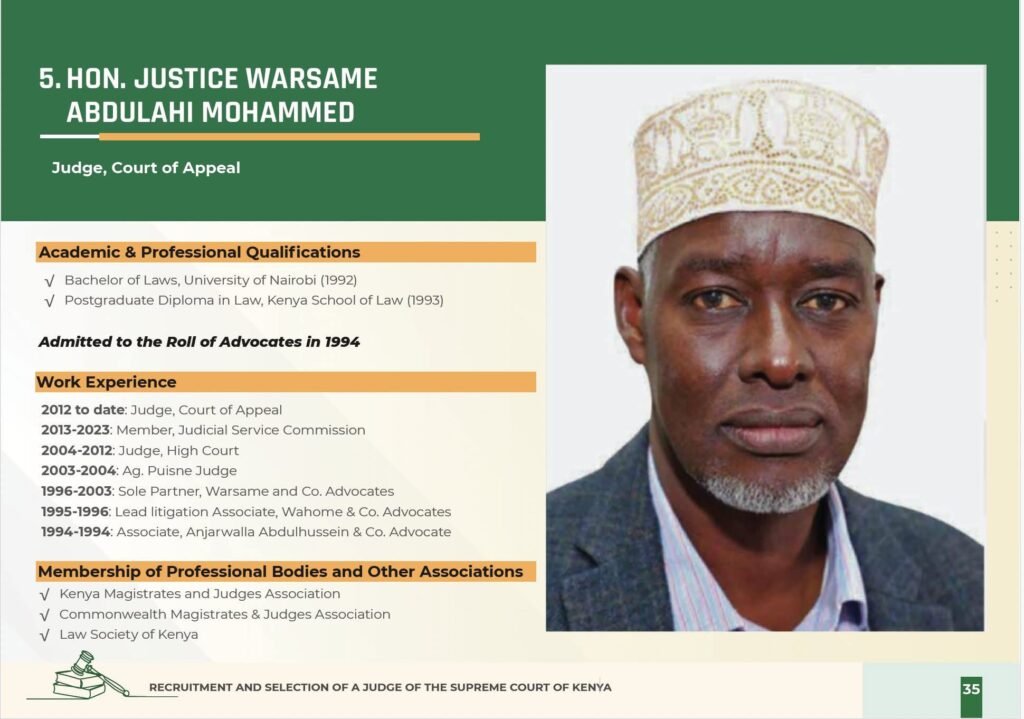
If formally appointed, Warsame will ascend from the Court of Appeal of Kenya, where he has served since 2012, to the apex bench charged with final interpretation of the Constitution.-
Who is Justice Mohamed Warsame?
A jurist shaped by both private practice and public service, Warsame built his early career at the Bar before transitioning to the High Court, where he earned a reputation for firm case management and crisp rulings. His elevation to the Court of Appeal in 2012 placed him at the centre of Kenya’s evolving constitutional order following the 2010 Constitution.
Across more than a decade on the appellate bench, colleagues and litigants alike have come to associate Warsame with three defining traits: procedural discipline, plain-spoken reasoning, and a cautious but steady fidelity to constitutional text.
Landmark Judgments and Jurisprudence
While not a judicial populist, Warsame’s opinions have frequently shaped core areas of law:
Commercial and Banking Law: He has been part of benches that clarified lenders’ obligations on statutory notices and borrower protections, tightening compliance thresholds for financial institutions and reinforcing due process in asset recovery.
Electoral Disputes: In high-stakes election appeals, Warsame has consistently underscored the primacy of evidence, often warning against “speculation dressed as grievance.” His rulings have contributed to a jurisprudence that prizes verifiable proof over political rhetoric.
Criminal Justice and Fair Trial Rights: Warsame has taken a firm line on procedural fairness—quashing convictions where due process was compromised, while equally insisting on the integrity of evidence chains in serious offences.
Administrative Law: His decisions have reinforced the doctrine that public bodies must act within statutory limits, echoing the constitutional demand for legality, rationality and procedural fairness.
Memorable Acts on and off the Bench
One of Warsame’s most defining public moments came during his tenure as a representative of the judiciary in the Judicial Service Commission itself. At a time of heightened tension between the bench and other arms of government, he emerged as a forthright defender of judicial independence, cautioning against intimidation and urging institutional respect for court orders.
He has also been known for calling out delays and inefficiencies within the justice system, pushing for tighter timelines and better case-flow management—an approach that has endeared him to litigants weary of protracted proceedings.
Pronouncements that Defined His Voice
Warsame’s courtroom language is direct, often cutting through legal fog with memorable phrasing:
On evidence in election disputes: Courts are arenas of proof, not platforms for political theatre.
On rule of law: Compliance with court orders is not optional; it is the foundation upon which constitutional governance rests.
On judicial duty: A judge must resist both pressure and popularity, deciding only on law and fact.These statements, frequently cited in legal circles, capture a philosophy anchored in restraint, clarity and institutional authority.
What Next?
Following nomination by the Judicial Service Commission, Warsame’s name now proceeds through the formal appointment process to the Supreme Court of Kenya. If confirmed, he will join a bench tasked with settling the country’s most consequential disputes—constitutional interpretation, presidential election petitions and matters of national jurisprudential direction.
For a judge long defined by measured reasoning rather than headline-grabbing flourish, the move to the apex court signals both continuity and consequence: a steady hand stepping into a court where every word carries constitutional weight.


