
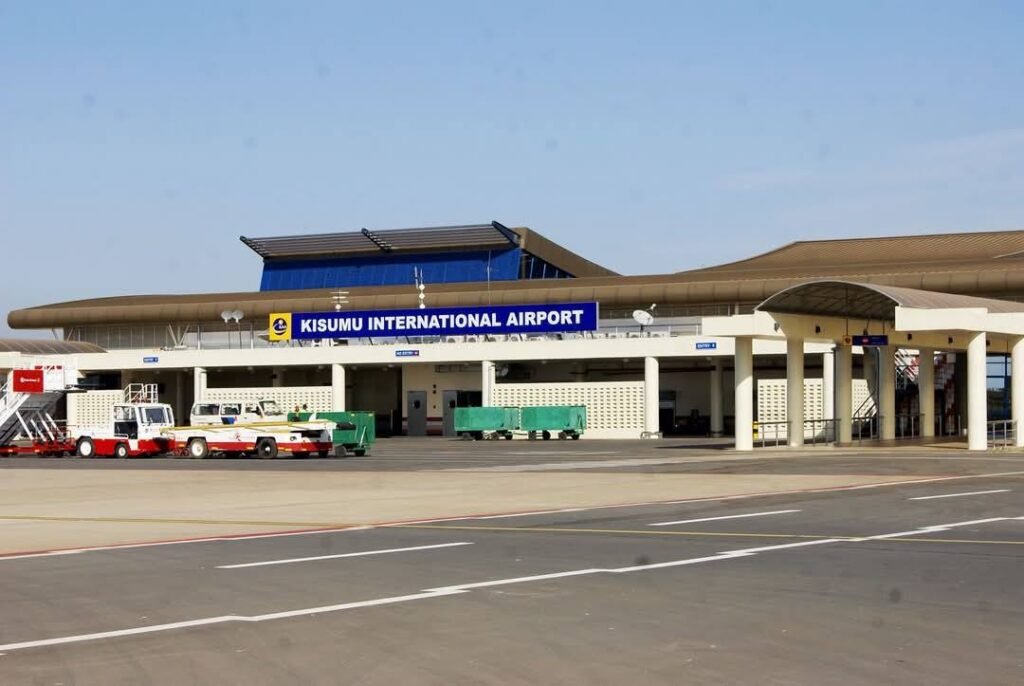
Kisumu International Airport (KIA) is fast evolving from a regional passenger facility into a strategic logistics and trade gateway for western Kenya and the wider Great Lakes region, driven by a KSh 4.9 billion national government expansion programme.

The upgrades are designed to reposition Kisumu as a cargo, export and connectivity hub, supporting agriculture, the blue economy, tourism and regional trade, while reducing dependence on Nairobi for air freight and international access.
Growth by the numbers and economic impact
Kisumu International Airport currently handles about 500,000 passengers annually, making it Kenya’s third-busiest airport after Jomo Kenyatta International Airport and Moi International Airport. With ongoing expansion works, the airport’s passenger handling capacity is expected to double to one million passengers per year by 2026.
The airport’s growth is already reshaping the local economy. In Kisumu County, the transport and storage sector has overtaken agriculture as the leading income earner, expanding by 72 percent and contributing an estimated KSh 65.4 billion to the county’s economy. This growth is closely linked to increased aviation activity, logistics services and regional connectivity anchored by the airport.
KIA serves as the main aviation hub for western Kenya and the Lake Region Economic Bloc, which brings together 14 counties with a combined population of approximately 14.9 million people.
Infrastructure upgrades driving the logistics shift
At the centre of Kisumu’s transformation is a series of major infrastructure investments scheduled for completion by 2026. These include a modern cargo terminal with specialised cold storage facilities to support direct exports of fresh fish, flowers, vegetables and avocados to global markets.
The runway, which currently measures about 3.3 kilometres, is slated for extension to up to 4.5 kilometres. This upgrade will allow Kisumu International Airport to handle wide-body aircraft such as the Boeing 777 and Airbus A330, fully loaded with cargo, eliminating the need for exporters to transport goods by road to Nairobi.
A key milestone was achieved in late 2025 with the completion of a new KSh 314 million, eight-storey Air Traffic Control tower equipped with advanced ICT, navigation and surveillance systems. The tower enhances aviation safety and enables Kisumu to manage airspace for parts of the wider Lake Region.
During an on-site inspection at Kisumu International Airport on December 16, 2025, Kenya Airports Authority Chairman Caleb Kositany said the upgrades were aimed at meeting global aviation standards. “The runway widening to Code 4E specifications is intended to elevate the facility to international standards and allow it to accommodate larger aircraft safely,” he said.
Why the Airport matters for logistics and trade
The airport’s expansion is designed to unlock export value for western Kenya by shortening supply chains and reducing logistics costs. Fresh produce and fish from the Lake Victoria region can now be exported directly by air, cutting transit times and preserving quality.
Speaking on April 22, 2025, during an official government briefing in Kisumu County published through MyGov, Deputy Chief of Staff Eliud Owalo said the upgrades were intended to transform the airport into an export engine. “We cannot have an airport that only carries bodies as cargo. Once the airport is upgraded, our fishermen will be able to export fish directly from Kisumu, attracting agro-processors, logistics companies and exporters,” he said.
The logistics vision is also linked to broader infrastructure plans, including the extension of the Standard Gauge Railway to Kisumu, which would create a seamless rail-to-air transport corridor for cargo destined for regional and international markets.
Regional connectivity and travel growth
Beyond logistics, Kisumu International Airport is strengthening regional integration by improving air links with neighbouring countries. The Kisumu–Entebbe route has reduced travel time for traders, investors and tourists across the Great Lakes region.
During the launch of the Kisumu–Entebbe flight at Kisumu International Airport on December 17, 2025, Kisumu Governor Prof Anyang’ Nyong’o described the airport as central to regional integration. He said the direct air link was “a major boost for regional integration, enabling faster movement of traders, investors and tourists without routing through Nairobi.”
President William Ruto has also linked the airport’s expansion to broader regional development plans. Addressing residents during his Nyanza development tour on Oginga Odinga Street in Kisumu City on January 30, 2026, the President said the airport’s growth was part of a wider strategy to strengthen trade and connectivity. He described the ongoing upgrades as positioning Kisumu “at the heart of regional and continental air connectivity” while supporting economic growth across western Kenya.
A strategic Hub taking shape
With expanded cargo handling, modern air traffic management systems and improved regional air links, Kisumu International Airport is steadily transitioning into a logistics and trade hub for the Lake Region and beyond.
As infrastructure works continue toward completion in 2026, the airport is expected to play a central role in boosting exports, attracting investment, supporting tourism and anchoring Kisumu’s emergence as a key economic gateway for East Africa.


