
The quest to transform Kenya into an industrial powerhouse is fundamentally an energy challenge, and President William Ruto is turning to deep-pocketed investors from the Gulf to solve it. In a high-stakes move under the recently inked Comprehensive Economic Partnership Agreement (CEPA), the government is seeking massive capital to dramatically scale up the nation’s electricity generation capacity to an ambitious 10,000 Megawatts (MW) by the year 2032.
This target is not just an aspiration; it is the cornerstone of the government’s economic agenda, explicitly aimed at overcoming the “limited power supply” that has constrained Foreign Direct Investment (FDI) and industrial growth, particularly in energy-intensive sectors like data centres.
The Power gap: current capacity vs. 2032 goal
For investors and economic planners, the numbers underscore the urgency and the scale of the required investment.
| Metric | Figure | Context |
| Current Installed Capacity | 3,192 MW (as of June 2025) | The benchmark for the expansion effort. |
| 2032 Generation Target | 10,000 MW | Represents a need to more than triple the current capacity in seven years. |
| Peak Demand (Oct 2025) | 2,411.98 MW | Highlighting the grid’s thin reserve margin and vulnerability. |
| System Energy Losses | 23.36% (in the year to June 2025) | Nearly one in four units generated is lost, demanding huge investment in grid modernization alongside new generation. |
This dramatic expansion will primarily be financed through Public-Private Partnerships (PPPs), a critical shift designed to mobilize private capital and lessen the reliance on public debt.
Read more
Everything You need to know about NYOTA Program
Lenku, Ntutu and Letilel Praise Ruto,s Courage
The cost of ambition: mobilizing KSh Trillions
While a precise figure for the 10,000MW expansion is yet to be fully costed, the scale of investment is clearly in the trillions of Shillings. Broader climate action and infrastructure targets provide a context for the capital requirements:
- KSh 6,775 billion (approx. USD $65 billion): This is the estimated total financing needed for Kenya’s National Climate Change Action Plan (NCCAP) from 2020 to 2030, a plan heavily reliant on expanding clean energy infrastructure.
- The entire energy sector (power and transmission) is expected to require investments in the range of USD 30 to $50 billion by 2030 to achieve long-term expansion goals and modernization.
To date, Independent Power Producers (IPPs) have already attracted at least USD $2.5 billion into geothermal, wind, and solar projects, but the 10,000MW goal necessitates a colossal acceleration of capital inflows.
CEPA and deepening UAE trade ties
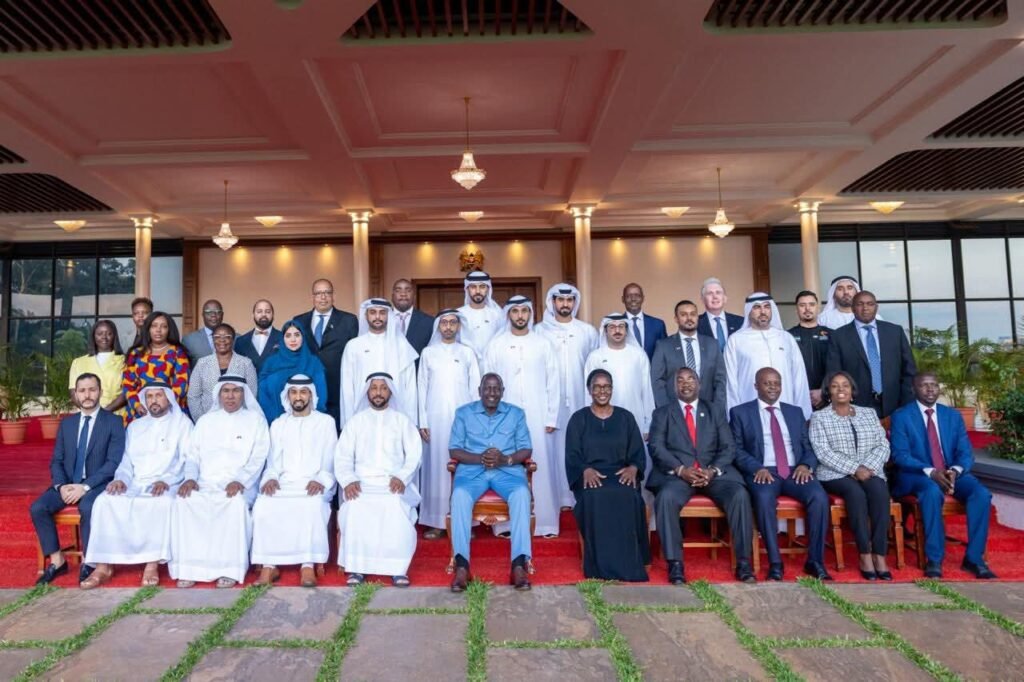
The partnership with Gulf investors, notably the delegation led by the Sharjah Chamber of Commerce & Industry, is anchored in the Kenya-United Arab Emirates Comprehensive Economic Partnership Agreement (CEPA). This landmark deal, the first of its kind between the UAE and a mainland African country, provides the stable economic framework necessary to underwrite such large-scale projects.

The existing trade relationship between the two nations is already robust:
- Total Bilateral Trade (2023): Sh445 billion.
- UAE’s Ranking: Kenya’s second-largest import source and sixth-largest export destination.
- Key 2023 Exports to UAE:
- Meat and meat products: Sh9.9 billion
- Fruits: Sh5.2 billion
- Vegetables and Flowers: Sh5.6 billion
By strengthening this alliance, Kenya seeks not only energy investment but also a deeper engagement across critical economic sectors, including infrastructure, ICT, and the digital economy.
Infrastructure and food security
The partnership extends beyond the power sector, targeting a holistic overhaul of national infrastructure. The government also plans to roll out similar PPPs for:
- Water & Agriculture: The construction of 50 mega dams to boost irrigation and enhance food production, directly linking energy reliability with food security.
- Transport: Major projects include the development of 1,500km of dual carriage highways and 10,000km of tarmac roads, alongside the modernization of key ports and airports.
This integrated approach aims to create a cohesive infrastructure network capable of sustaining the high-growth industrial economy that the 10,000MW power target is designed to support. The success of this strategy hinges on the rapid and verifiable delivery of these mega-projects through the proposed Gulf-backed PPP mode


