
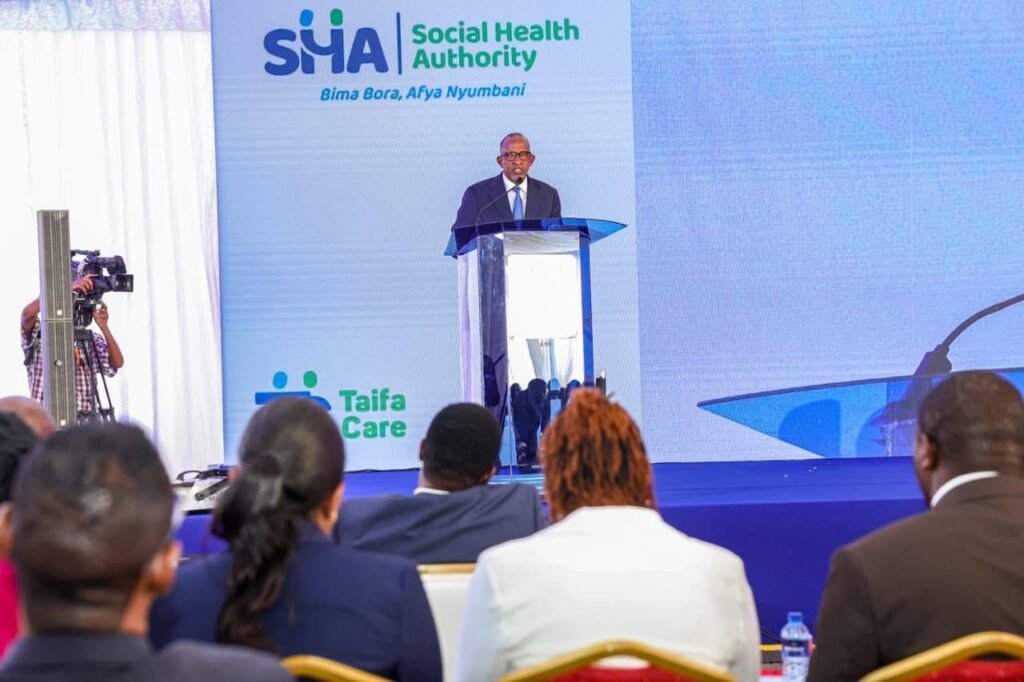
The Ministry of Health, led by Health Cabinet Secretary Aden Duale alongside Public Service CS Geoffrey Ruku, has launched the mandatory nationwide biometric registration exercise targeting school-aged dependents between 7 and 17 years old under the Social Health Authority (SHA) system.
Managed technically by the Digital Health Agency (DHA), 8,067 biometric scanners have been deployed to public health facilities countrywide to link minors to their principal beneficiaries in real time at the point of care, eliminating the need for a national identity card.
Why is biometric registration mandatory for children aged 7–17?
The rollout serves as a multi-layered preventative shield to curb rampant medical billing fraud, impersonation, and duplicate healthcare claims within the state insurance framework.
Many parents have asked why children under the age of seven are excluded from physical scanning. According to the Digital Health Agency (DHA), human fingerprints are not scientifically stable or mature before age seven. Therefore, dependents under 7 years old will continue to access healthcare services through the standard verification link on their principal guardian’s profile without undergoing physical scans.
For school-aged children, the system creates a permanent digital link between the minor and their medical history. Once registered, a child’s immunization logs, clinical history, and treatment records are securely bound to their biometric profile and instantly accessible at any SHA-affiliated hospital nationwide.
Step-by-Step Point of Care Registration Procedure
The biometric registration is handled at the hospital registration desk during admission or treatment. Parents do not need to visit a separate government office. Follow these specific steps to clear the process smoothly:
1.Verify Principal Status:Step 1: Account Check.
The healthcare worker will first verify that the parent or legal guardian’s principal SHA account is active and fully paid up. This is done by scanning the adult’s biometrics or running their national identity card number through the portal.
2.Present Dependent Documentation:Step 2: Verification.
Provide the healthcare worker with the minor’s Birth Certificate Number or NEMIS (National Education Management Information System) number. The agent keys this into the SHA portal to verify the relationship link on the family tree.
3.Capture Biometric Data:Step 3: Scanning.
The child places their thumb and index fingers on the newly deployed DHA biometric terminal. The system captures and encrypts the ridge lines, uploading the signature straight to the secure SHA cloud infrastructure.
4.Generate Unique Medical ID:Step 4: Final Link.
The system binds the child’s biometrics directly to the parent’s profile. A permanent medical record ID is generated instantly, authorizing immediate care under the updated tariff allocations.
Troubleshooting Common Registration and Portal Errors
Because the system relies on central cloud synchronization, users and hospital clerks are experiencing day-to-day platform issues. Here is how to resolve the most common edge cases:
| Common System Error | What Happens | The Ground-Truth Workaround |
| Fingerprint Capture Failure | The scanner fails to read faint or worn ridge lines on school-aged children. | The attendant triggers the Mobile OTP Bypass System. A 6-digit verification code is pushed to the principal beneficiary’s registered mobile number to clear the child manually. |
| Beneficiary Mismatch Error | The portal states the child cannot be linked to the adult’s account. | This occurs if birth data isn’t sync’d on eCitizen. The parent must log into their personal SHA web portal, navigate to the “Dependents” tab, and manually upload a clean digital scan of the birth certificate. |
| Terminal Offline / Network Error | The local hospital facility experiences local internet downtime or server lag. | Under strict Ministry of Health emergency guidelines, hospitals are legally prohibited from denying care. The facility must treat the child, record manual logs, and cache the biometrics on the device for auto-syncing later. |
Special Boost for Civil Servants and Public Officers
The launch of the minor biometric system explicitly coincided with the formalization of the Public Officers Medical Scheme Fund (POMSF) contracts. Signed alongside county governors and medical unions, the new scheme allows public servants and their biometrically verified dependents to access specialized medical care across Level 3 to Level 6 facilities without illegal, out-of-pocket expenses.
Critical Warning for Hospitals: Health CS Aden Duale has issued a strict warning to public and private facilities attempting to impose unauthorized co-payments or failing to dispense required drugs to SHA patients. “If you fail to give medicine to our patients under the scheme, I will make an immediate deduction of close to 38 percent on your hospital’s financial claim,” the CS cautioned.
Through these updated contracts, verified dependents can now access extensive inpatient packages, cancer treatments, chemotherapy, long-term renal dialysis, optical/dental portfolios, and advanced reproductive health options like In Vitro Fertilization (IVF) seamlessly.


