
Kenya has registered 8.9 million farmers on its national agricultural information system, Agriculture Cabinet Secretary Mutahi Kagwe has said, as the Government expands the use of digital records, soil testing and drones to improve farm productivity.
Speaking at the Nairobi International Trade Fair, Kagwe said the Kenya Integrated Agricultural Management Information System (KIAMIS) would help the Government target subsidised fertiliser, certified seeds and livestock services more accurately.
The registration, he said, provides a foundation for identifying farmers, delivering support and accounting for public investment in agriculture.
But Kagwe warned that access to inputs alone would not solve the country’s productivity challenges. Farmers also need reliable information about the condition of their land.
Soil health takes priority
Kagwe cited soil acidity as a major constraint, saying about 63 per cent of Kenya’s arable land is acidic. He raised the same concern during the September 29 launch of a national soil-testing initiative at the Kenya Agricultural and Livestock Research Organization (KALRO) in Kabete.

“Our business as the ministry, and government is the soil health, not the fertilizer,” he said at the trade fair.
He compared applying farm inputs without assessing the soil to taking medicine without a proper diagnosis, warning that farmers could spend money on products that do not address their land’s needs.
The Government’s soil-testing push will connect laboratory analysis, research and advisory services to help farmers make better decisions about fertiliser use and land management.
Kagwe said collaboration between KALRO, county governments, private-sector players and locally based soil doctors would expand access to testing and bring scientific advice closer to farmers.
Drones and digital addresses
Alongside farmer registration, Kagwe outlined partnerships intended to improve how agricultural services reach farms.
Through Fahari Aviation, a Kenya Airways subsidiary, the ministry plans to deploy drones for precision application of inputs, crop and livestock monitoring, and detection of pests, diseases and climate-related risks.
A separate partnership with MPost will introduce digital addressing to help service providers identify and locate farmers.
Kagwe said this would support the delivery of extension services and improve farmers’ connections to finance, insurance, inputs and markets.
“It means extension services can reach the right person at the right time,” he said.
He also said the Government’s agricultural data centre, KADIC, would coordinate information and technology across the sector, helping close gaps in farmer identification, advisory services and market access.
The partnerships, he added, would support the development of local artificial intelligence capacity, accompanied by oversight and data-protection frameworks.
Livestock investments target markets
Kagwe said the Government was also investing in livestock infrastructure to connect producers to more valuable markets.
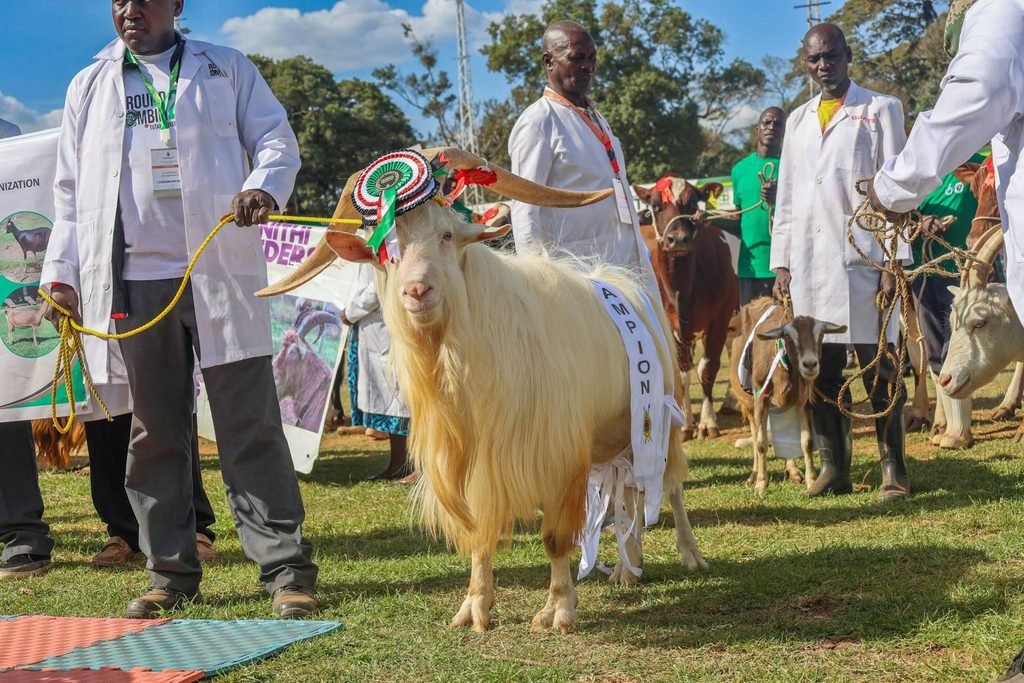
Over the preceding three weeks, he said, he had assessed the market readiness of the Isiolo Abattoir and handed over the Bachuma National Livestock Quarantine Centre to private investors.
The facilities, together with animal identification and traceability through ANITRAC, are intended to strengthen livestock value chains and support access to export markets.
Kagwe reported that the value of marketed livestock production rose from KSh232.3 billion in 2024 to KSh269.4 billion in 2025.
He nevertheless called for more reliable supplies of affordable animal feeds and wider insurance coverage, noting that dry conditions had contributed to recent milk supply constraints.
Higher incomes are the test
Kagwe said climate variability, production costs and changing market demands continued to put pressure on agriculture.
The Government, he said, was accelerating irrigation investment through rehabilitation of existing schemes, new infrastructure and water-efficient technologies. It was also promoting drought-tolerant crops, conservation agriculture and sustainable land management.
Beyond production, Kagwe identified processing, storage and market access as priorities for improving farmer earnings.
He said mobile dryers and other equipment would help reduce post-harvest losses, while the Warehouse Receipt System could help farmers store produce, access financing and avoid selling immediately at unfavourable prices.
“Our approach is not simply about producing more, but about earning more from what we produce,” he said.
Kagwe urged stronger cooperatives and farmer aggregation, alongside investment in cold storage and transport links. He said opportunities for young people and women extended beyond farming into processing, technology, finance and logistics.
The success of the reforms, he said, would be measured by timely services, improved productivity and higher farmer incomes.
“What matters now is execution.”


