
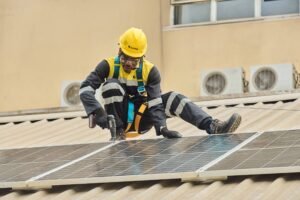


The government has entered into a partnership with Kenya Commercial Bank (KCB) to support the installation of solar power and energy-efficiency systems in public universities.
The agreement, signed by the State Department for Higher Education and KCB, is expected to provide universities with a financing framework for acquiring, installing and maintaining renewable-energy systems.
Higher Education and Research Principal Secretary Beatrice Muganda said the partnership will allow universities to assess their energy needs and identify facilities where solar power can provide the greatest benefit.
“I signed a Memorandum of Understanding (MOU) between the State Department for Higher Education and KCB Bank Kenya Limited to support the solarisation of our university institutions,” Muganda said.
Universities to undergo energy assessments
The programme will not involve installing identical systems across all institutions.
Universities and KCB will first examine historical electricity consumption and conduct detailed assessments of individual facilities to determine the most appropriate solar solutions.
The assessment will help identify buildings and facilities with significant energy demands and determine the scale of solar systems required.
Muganda said the approach is intended to ensure that investments are guided by actual institutional power needs rather than a one-size-fits-all model.
KCB to provide financing
Under the agreement, eligible university facilities will be supported through asset-based financing arrangements.
This will enable institutions to transition to solar energy through a structured financing model while also providing a framework for the maintenance of the installed systems.
The partnership is therefore expected to address not only the initial cost of installing solar equipment but also the longer-term sustainability of the systems.
For public universities, which operate large campuses with lecture halls, laboratories, hostels, libraries and administrative buildings, reducing reliance on conventional electricity could help ease pressure from energy costs.
Students to gain practical solar skills
The government says the initiative will also have an education and skills-development component.
Muganda stressed that students and university technicians should be involved in the programme instead of simply observing the installation of imported equipment.
“We should not import equipment, install it and leave our students and technicians watching from the sidelines,” she said.
“Our young people must acquire the skills to design, install, operate, maintain and improve these systems.”
The PS said the partnership should create opportunities for students and university staff to gain hands-on experience in renewable-energy technologies.
Beyond installing solar panels
The agreement places emphasis on energy efficiency alongside solar generation.
This means universities will first assess how electricity is consumed within their facilities and identify opportunities to reduce unnecessary energy use before or alongside the adoption of solar systems.
The combination could allow institutions to lower their overall energy demand while increasing the share of power generated from renewable sources.
What the partnership means for public universities
Public universities are among the largest institutional consumers of electricity because of the size and complexity of their operations.
A successful solarisation programme could help institutions manage energy costs while improving their resilience against disruptions in electricity supply.
It could also give universities an opportunity to become training grounds for Kenya’s growing renewable-energy sector by allowing students and technical staff to gain practical experience with solar technologies.
The government and KCB will now work with participating institutions to identify suitable facilities, conduct the required assessments and determine the financing and technical requirements for individual projects.


