
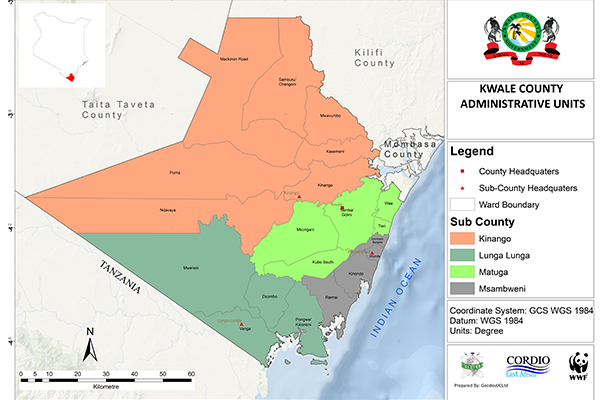
1. Basic Identity
Official name: County Government of Kwale / Kwale County
County code: 002
County headquarters: Kwale Town
Region: Coast Region
Area: Approximately 8,270.2 square kilometres
2019 population: 866,820 — 425,121 males, 441,681 females and 18 intersex persons, according to the Kenya Population and Housing Census.
Kwale County is located in the southern part of Kenya’s Coast region. It borders Mombasa and Kilifi counties to the north, Taita-Taveta County to the west, Tanzania to the south and the Indian Ocean to the east.
Although Kwale Town is the administrative headquarters, Ukunda and Diani form the county’s most important commercial and tourism centres. Diani in particular has developed into one of Kenya’s best-known international beach destinations.
Kwale’s economy combines tourism, agriculture, mining, fishing, livestock, trade and emerging blue-economy activities. The county is also strategically positioned along the Mombasa–Lunga Lunga–Tanzania corridor, making it important for cross-border commerce.
Its cultural identity is strongly associated with the Digo, Duruma and other Mijikenda communities, whose traditions, languages, music, food and social institutions form an important part of the county’s heritage.

2. Political and Administrative Structure
Kwale County has four parliamentary constituencies and 20 County Assembly wards.
A. Msambweni Constituency — 4 wards
- Gombato Bongwe
- Ukunda
- Kinondo
- Ramisi
B. Lunga Lunga Constituency — 4 wards
- Pongwe/Kikoneni
- Dzombo
- Mwereni
- Vanga
C. Matuga Constituency — 5 wards
- Tsimba Golini
- Waa
- Tiwi
- Kubo South
- Mkongani
D. Kinango Constituency — 7 wards
- Ndavaya
- Puma
- Kinango
- Mackinnon Road
- Chengoni/Samburu
- Mwavumbo
- Kasemeni
Total: 4 constituencies and 20 wards.
The political structure is complemented by national-government administrative units, including sub-counties, locations and sub-locations.
One of Kwale’s geographical and administrative peculiarities is the contrast between the densely populated coastal tourism belt around Ukunda and Diani and the much more sparsely populated inland areas of Kinango and parts of Lunga Lunga.
3. Current Political Leadership
As of August 2026:
| Position | Office holder |
|---|---|
| Governor | Hon. Fatuma Mohamed Achani |
| Deputy Governor | Hon. Chirema Kombo |
| Senator | Hon. Issa Boy Juma |
| Woman Representative | Hon. Fatuma Masito |
Governor Fatuma Achani
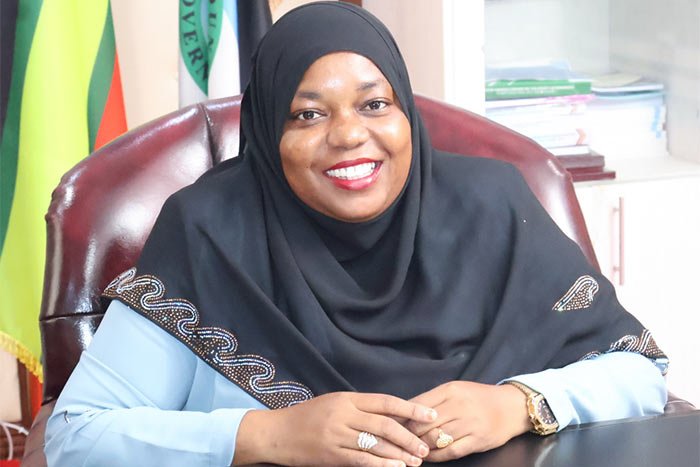
Fatuma Mohamed Achani became the first woman elected Governor of Kwale County in the 2022 General Election.
Before becoming governor, Achani served as Deputy Governor of Kwale during the administration of former Governor Salim Mvurya. Her political career has therefore given her experience in both county executive administration and grassroots politics.
Her administration has emphasised areas including:
- Early childhood education
- Healthcare
- Agriculture
- Water provision
- Youth empowerment
- Women’s economic empowerment
- Tourism
- Infrastructure
- Blue-economy development
Her election was particularly significant because it increased women’s representation in political leadership at the Coast.
4. Members of Parliament
Kwale has four constituencies and four Members of the National Assembly.
| Constituency | Member of Parliament | Party |
|---|---|---|
| Msambweni | Hon. Feisal Abdallah Bader | UDA |
| Lunga Lunga | Hon. Mangale Munga Chiforomodo | UDM |
| Matuga | Hon. Kassim Sawa Tandaza | ANC |
| Kinango | Hon. Samuel Gonzi Rai | PAA |
Kwale’s parliamentary representation illustrates the county’s politically competitive character. Unlike counties where one political party dominates virtually all constituencies, Kwale has historically produced a mixture of parties and political alliances.
The county’s politics are also influenced by national Coast politics, development questions, land issues, tourism, mining and the relationship between coastal communities and successive national governments.
5. Economy and Gross County Product
Kwale is one of Kenya’s important coastal economies, with a diverse economic base extending beyond tourism.
Its major economic pillars include:
- Tourism and hospitality
- Mining and mineral extraction
- Agriculture
- Livestock
- Fishing and aquaculture
- Wholesale and retail trade
- Transport and logistics
- Construction and real estate
- Manufacturing and agro-processing
- Cross-border trade
The KNBS Gross County Product (GCP) series provides the principal official measure of the county’s economic output. Kwale’s economy has expanded substantially over the GCP reporting period, although its national contribution remains much smaller than that of Nairobi, Kiambu, Nakuru and other major economic centres.
The county’s economic structure is unusual because it combines a globally recognised tourism industry with a major mineral-extraction economy and predominantly rural agriculture.
Tourism
The Diani tourism belt is one of Kenya’s major sources of international and domestic beach tourism revenue.
Hotels, restaurants, resorts, tour operators, diving companies, transport businesses and informal traders collectively create thousands of direct and indirect jobs.
Mining
Mining is another major component of Kwale’s economy.
The Kwale Mineral Sands Project, associated with the extraction of ilmenite, rutile and zircon, has made Kwale an important location in Kenya’s mineral-export industry.
Mining has generated employment, infrastructure investment and export earnings, while also producing debates about land acquisition, environmental management, compensation and community benefits.
Blue economy
Kwale’s long Indian Ocean coastline gives it substantial potential in:
- Fishing
- Seaweed farming
- Aquaculture
- Marine tourism
- Fish processing
- Coastal transport
- Marine conservation
The development of blue-economy value chains is increasingly viewed as an opportunity to diversify the county beyond conventional tourism.
6. Agriculture: The Rural Economic Engine
Agriculture remains one of Kwale’s most important sources of employment and household income.
The county contains several ecological zones, ranging from relatively productive coastal areas to the drier inland Nyika plateau.
Major crops
Coconut
Coconut is one of the county’s most recognisable traditional crops. It supports household consumption, local markets and value-added products including coconut oil and other processed products.
Cashew nuts
Cashew is an important coastal cash crop with considerable potential for processing and export.
Mangoes
Mango production is widespread and contributes to household incomes and local trade.
Cassava
Cassava is particularly important as a food-security crop because of its ability to tolerate relatively dry conditions.
Maize
Maize remains an important staple crop, particularly for household food security.
Sugarcane
Sugarcane is grown in parts of the county and contributes to the agricultural economy.
Bixa/annatto
Bixa is another commercial crop with potential for processing and specialised export markets.
Other crops include:
- Cowpeas
- Green grams
- Beans
- Sweet potatoes
- Vegetables
- Bananas
- Pineapples
The major challenge is not simply production but value addition, irrigation, storage, transport and access to reliable markets.
7. Livestock and Fisheries
Livestock production is particularly important in the drier inland parts of the county.
Major livestock include:
- Beef cattle
- Goats
- Sheep
- Indigenous poultry
- Broilers and layers
- Pigs in smaller quantities
Goat and cattle keeping is especially important in Kinango and other relatively dry areas, where pastoral and agro-pastoral production systems are common.
Fisheries
Kwale’s location along the Indian Ocean provides an important marine-fisheries economy.
Fishing communities operate along the coastline, with fish providing:
- Food
- Household income
- Employment
- Restaurant supplies
- Local trade
The county also has potential for aquaculture, seaweed farming and fish processing, making fisheries an important part of its emerging blue economy.
8. Key Industries
Kwale’s principal industries and economic activities include:
Tourism and hospitality
The Diani–Ukunda area contains hotels, resorts, restaurants, tour companies and marine recreation businesses.
Mineral extraction
The Kwale Mineral Sands Project is one of the country’s most important mineral operations.
Food processing
Agricultural products such as coconut, cashew, mangoes and other crops provide opportunities for processing.
Fishing and seafood
Marine fishing and seafood trading support coastal communities and hospitality businesses.
Construction
Tourism, residential development and infrastructure have stimulated construction activity, especially around Diani and Ukunda.
Retail and wholesale
Ukunda is an important commercial centre serving the wider southern Coast region.
Transport and logistics
The Mombasa–Lunga Lunga corridor connects Kwale to Tanzania and forms an important trade route.
Handicrafts and cultural industries
Traditional crafts, clothing, woodwork and coastal cultural products contribute to tourism-related livelihoods.
9. Population
The 2019 Kenya Population and Housing Census recorded 866,820 residents in Kwale County.
The county has a significant rural population, although the Ukunda–Diani corridor has experienced rapid urbanisation because of tourism, migration, construction and commercial activity.
Kwale therefore has two contrasting demographic landscapes:
- A rapidly urbanising coastal belt
- A predominantly rural inland population
The county’s population is also relatively young, creating both an opportunity for economic growth and a major demand for jobs, education, healthcare and skills development.
10. Education and School Enrolment
Education access has improved substantially through government investment in free primary education, secondary-school expansion and county-supported ECDE programmes.
Kwale’s education system includes:
- Early Childhood Development Education (ECDE) centres
- Public and private primary schools
- Secondary schools
- Technical and vocational institutions
- Teacher-training institutions
- Higher education institutions
The county continues to face challenges involving:
- School dropout
- Poverty
- Long distances to schools in remote areas
- Adolescent pregnancy
- Transition from primary to secondary school
- Limited infrastructure in some rural schools
- Unequal educational outcomes between urban and rural areas
County government investment in ECDE classrooms, learning materials and feeding programmes has been particularly important in improving early-childhood access.
Kwale also benefits from institutions such as Taita Taveta University facilities serving the wider region, technical and vocational education centres, and tertiary institutions around Ukunda and the Coast region.
For final statistical publication, enrolment and transition figures should preferably be taken from the latest KNBS, Kenya Economic Survey, Ministry of Education and Kwale County Statistical Abstract rather than older estimates.
11. Key Health Facilities
Kwale’s health system consists of county hospitals, sub-county facilities, dispensaries, health centres and private/mission hospitals.
Important facilities include:
Msambweni County Referral Hospital
Msambweni County Referral Hospital is one of the county’s principal public referral facilities and serves a large population across southern Kwale.
It provides services including:
- Outpatient care
- Inpatient services
- Maternity
- Surgery
- Laboratory services
- Emergency care
- Specialist clinics
Kwale County Referral Hospital
Located near the county headquarters, it is an important public health facility serving residents around Kwale Town and surrounding areas.
Kinango Sub-County Hospital
Provides medical and referral services to communities in the county’s large inland constituency.
Lunga Lunga Sub-County Hospital
Serves communities in the southern part of the county, including populations around the Tanzania border.
Private and mission facilities
The Diani–Ukunda tourism zone has a growing network of private hospitals, clinics and specialised healthcare providers.
The county’s health priorities include maternal and child health, infectious diseases, non-communicable diseases, water and sanitation, and improving access to healthcare in remote rural communities.
12. History of County Political Leadership
Kwale’s political leadership under Kenya’s devolved system began in 2013.
1. Salim Mvurya — 2013–2022
Salim Mvurya became Kwale’s first elected governor in 2013 and was re-elected in 2017.
His administration focused heavily on:
- Infrastructure
- Education
- Healthcare
- Agriculture
- Tourism
- Water
- Investment promotion
Mvurya later entered national politics and served as Cabinet Secretary for Mining, Blue Economy and Maritime Affairs.
2. Fatuma Achani — 2022–present
Fatuma Achani succeeded Mvurya after winning the 2022 gubernatorial election.
She became the first woman elected governor of Kwale County, marking an important moment in the political history of the Coast region.
Her administration has emphasised social services, agriculture, ECDE, healthcare and women’s and youth empowerment.
Senators
Kwale’s elected senators since devolution include:
- Nicholas Zani — 2013–2017
- Issa Boy Juma — 2017–2022
- Issa Boy Juma — 2022–present
Women Representatives
The county’s Woman Representative position has been held by:
- Zuleikha Juma Hassan — 2013–2017
- Hafsa M. Ali — 2017–2022
- Fatuma Masito — 2022–present
The growth of women’s representation is particularly significant in a county where women have historically played important roles in agriculture, tourism, community organisations and small-scale trade.
13. Kwale’s Political and Social “Quirks”
1. Diani and Kwale Town feel like two different economic worlds
Kwale Town is the administrative headquarters, but Diani and Ukunda are the county’s tourism and commercial powerhouses.
This creates an unusual situation in which the county government is headquartered away from its most internationally recognised economic destination.
2. Tourism and mining coexist
Few Kenyan counties combine a globally recognised luxury tourism destination with a major mineral-sands mining industry.
This creates both economic opportunities and debates about environmental sustainability and land rights.
3. The county has a strong Mijikenda identity
The Digo and Duruma are among the major communities in Kwale, alongside other Mijikenda groups and communities that have settled along the coast.
Traditional culture remains visible through language, food, music, dress and community institutions.
4. Kaya forests are both cultural and environmental assets
The sacred Kaya forests are associated with the Mijikenda and have been recognised internationally for their cultural importance.
They demonstrate how environmental conservation and cultural heritage can overlap.
5. Kwale is a border county
The Lunga Lunga corridor connects Kenya to Tanzania, giving Kwale an important role in:
- Cross-border trade
- Transport
- Immigration
- Tourism
- Regional integration
6. Diani has an international identity
Diani is known far beyond Kenya and regularly appears in international rankings of African beach destinations.
Its international profile makes tourism one of Kwale’s most visible connections to the global economy.
14. Main Annual and Recurring Events
Diani Beach Festival
The Diani area hosts various tourism, music, food and cultural events that bring together residents, domestic tourists and international visitors.
Kwale Agricultural Shows and Field Days
Agricultural events provide platforms for farmers to showcase livestock, crops, technology and value-added products.
Cultural festivals
Traditional music, dance, food and Mijikenda cultural celebrations form an important part of the county’s cultural calendar.
Madaraka Day and national celebrations
Kwale occasionally hosts major national celebrations, attracting political leaders and visitors from across Kenya.
Diani International Marathon
The Diani area has hosted sporting and tourism-oriented running events, reinforcing the destination’s growing sports-tourism profile.
Marine and conservation events
Beach clean-ups, marine conservation campaigns, turtle protection activities and environmental events are regularly organised along the coast.
These events combine tourism promotion with conservation and community participation.
15. Tourism: What Makes Kwale Different?
1. Diani Beach
Diani Beach is arguably Kwale’s most internationally recognisable tourism asset.
Its white sand, turquoise Indian Ocean waters, coral reefs, palm-lined coastline and luxury resorts have made it one of Africa’s leading beach destinations.
It stands out because it combines:
- Luxury resorts
- Water sports
- Diving
- Deep-sea fishing
- Kitesurfing
- Marine wildlife
- Restaurants
- Nightlife
- Local Swahili culture

2. Shimba Hills National Reserve
Shimba Hills is one of Kenya’s most important coastal wildlife reserves.
It is particularly famous for the sable antelope, one of Africa’s most distinctive and endangered antelope species.
The reserve also contains:
- Elephants
- Buffalo
- Leopards
- Giraffes
- Waterbuck
- Serval cats
- Numerous bird species
Its combination of wildlife, forests, waterfalls and elevated landscapes makes it different from the typical lowland safari experience.
3. Mwaluganje Elephant Sanctuary
Mwaluganje is a community-oriented conservation area established to protect elephants and their habitat.
It demonstrates an important Kenyan conservation model in which communities participate directly in wildlife protection and benefit from conservation-related activities.
4. Kaya Kinondo Sacred Forest
Kaya Kinondo is both a natural forest and a sacred cultural site.
It is associated with the Digo community and the wider Mijikenda cultural tradition.
Its importance extends beyond tourism because it represents the connection between indigenous cultural practices, spirituality and environmental conservation.
5. Kisite-Mpunguti Marine National Park
Located off the southern Kenyan coast near Shimoni, Kisite-Mpunguti is one of Kenya’s premier marine tourism destinations.
Visitors can experience:
- Coral reefs
- Dolphins
- Sea turtles
- Tropical fish
- Diving
- Snorkelling
- Boat excursions
It stands out because of its exceptional marine biodiversity and clear tropical waters.
6. Wasini Island and Shimoni
Wasini Island and the nearby Shimoni area provide access to marine tourism and coastal cultural experiences.
The region is particularly associated with:
- Traditional dhow trips
- Seafood
- Coral gardens
- Marine wildlife
- Swahili culture
- Historical sites
16. Key Personalities from Kwale
Salim Mvurya
Salim Mvurya was Kwale’s first governor and served two terms from 2013 to 2022. He later became a national Cabinet Secretary, giving Kwale one of its strongest links to national government.
Fatuma Achani
Fatuma Achani made history by becoming Kwale’s first elected female governor in 2022. Her political rise represents an important development in women’s leadership at the Coast.
Issa Boy Juma
Issa Boy Juma is a prominent Kwale politician who has represented the county in the Senate and has remained an influential figure in Coast politics.
Zuleikha Juma Hassan
Zuleikha Juma Hassan was Kwale’s first elected Woman Representative under devolution and contributed to the county’s early experience with the new constitutional representation structure.
Suleiman Shahbal
Suleiman Shahbal is a prominent Kenyan businessman and politician associated with the Coast region and Kwale’s wider political and commercial environment.
Mijikenda cultural leaders
Kwale has also produced numerous cultural leaders, conservationists, community organisers and businesspeople whose influence is often exercised at community level rather than through national political office.
17. The Kwale Paradox
Kwale is a county of remarkable contrasts.
It has:
- One of Africa’s most famous beach destinations;
- A major mineral-sands mining operation;
- Shimba Hills National Reserve;
- Important marine conservation areas;
- A strategic Kenya–Tanzania border corridor;
- A large agricultural population;
- Significant livestock resources;
- A growing blue economy;
- Strong Mijikenda cultural heritage;
- And substantial tourism potential.
Yet the county continues to face significant development challenges.
The contrast is particularly visible between Diani, where international resorts, luxury hotels and tourism businesses generate substantial economic activity, and poorer rural communities where households continue to depend heavily on subsistence agriculture and livestock.
The central economic challenge for Kwale is therefore not simply attracting visitors or extracting minerals. It is ensuring that tourism, mining, agriculture and the blue economy generate greater local value, employment and community benefits.
The county has an opportunity to develop an integrated coastal economy based on:
tourism + agriculture + mining + marine resources + manufacturing + cross-border trade.
If value addition and infrastructure improve, Kwale could become one of Kenya’s most diversified coastal economies.
References
Kenya National Bureau of Statistics (KNBS)
2019 Kenya Population and Housing Census
https://www.knbs.or.ke/2019-kenya-population-and-housing-census/
KNBS Gross County Product
https://www.knbs.or.ke/gross-county-product/
KNBS Economic Surveys
https://www.knbs.or.ke/economic-survey/
County Government of Kwale
Official Kwale County Government website
https://kwale.go.ke/
Kwale County Integrated Development Plan (CIDP)
https://kwale.go.ke/
Commission on Revenue Allocation / County Government Information
Kwale County information
https://cra.go.ke/
Parliament of Kenya
National Assembly – Members
https://www.parliament.go.ke/the-national-assembly/members
Senate – Senators
https://www.parliament.go.ke/the-senate/senators
Independent Electoral and Boundaries Commission (IEBC)
IEBC official website
https://www.iebc.or.ke/
Kenya Institute for Public Policy Research and Analysis (KIPPRA)
County economic and labour productivity research
https://kippra.or.ke/
Kenya Wildlife Service
Shimba Hills National Reserve
https://kws.go.ke/parks/shimba-hills-national-reserve/
Kisite-Mpunguti Marine National Park and Reserve
https://kws.go.ke/
UNESCO
Sacred Mijikenda Kaya Forests – World Heritage
https://whc.unesco.org/en/list/1231/
Kenya Tourism Board
Magical Kenya – Kwale/Coast tourism information
https://magicalkenya.com/
National Museums of Kenya
Cultural heritage and Kaya sites
https://museums.or.ke/
Kenya Mining
Ministry of Mining, Blue Economy and Maritime Affairs
https://www.mining.go.ke/


