


Political leaders from Western Kenya and Nyanza are pushing for a new electoral alliance that they say could deliver more than seven million votes to President William Ruto in the 2027 General Election.
The proposal seeks to bring together Luhya and Luo political leaders who have traditionally supported different opposition formations, particularly those associated with the late former Prime Minister Raila Odinga.
But behind the campaign for unity is a bigger political calculation: whether the two regions can consolidate their votes behind Ruto in 2027 and, in return, use their combined electoral strength to negotiate a stronger position in the country’s politics beyond the election.
What is the proposed alliance?
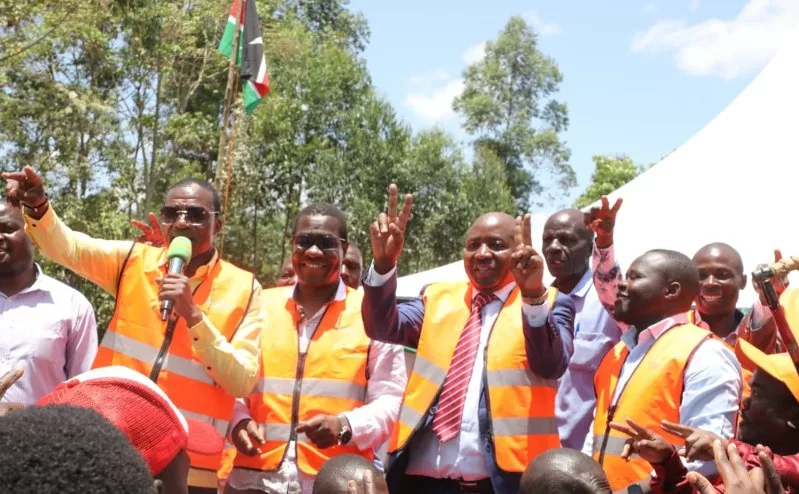
The initiative is being championed by Energy and Petroleum Cabinet Secretary Opiyo Wandayi and Kakamega Deputy Governor Ayub Savula, who have been mobilising leaders in Western and Nyanza.
The leaders argue that the two regions have enough votes to become a decisive force in the presidential election if they vote as a bloc.
Savula, who serves as deputy coordinator of Ruto’s Western regional campaign lobby, has urged leaders to begin building a joint political strategy that goes beyond the 2027 election.
He has called on the two regions to support Ruto, citing what he describes as the administration’s development record.
The proposal, however, is not yet a formal political alliance. It is currently a mobilisation effort aimed at creating a common political position among leaders from the two regions.
Why are Western and Nyanza important?
Western Kenya and Nyanza are among the country’s most politically significant regions because of their large voting populations.
For decades, political leaders from the two regions have played a major role in presidential elections, although their votes have not always been directed towards the same candidate.
The regions also became closely associated with Raila Odinga, whose political influence was particularly strong in Nyanza and extended into parts of Western Kenya.
The proposed realignment therefore represents an attempt to change an established political pattern.
Instead of largely backing opposition politics, the leaders promoting the initiative want the Luhya and Luo vote to become part of Ruto’s 2027 coalition.
Where does the seven-million-vote figure come from?
The seven-million figure is being used by the political leaders to illustrate the potential combined strength of Western and Nyanza.
Their argument is straightforward: if the two regions coordinate their voting patterns and mobilise behind one presidential candidate, they can become a powerful bargaining bloc.
However, the figure should not be interpreted as a guaranteed number of votes for Ruto.
Voting patterns vary between counties, constituencies, communities and individual voters. Previous elections have also demonstrated that political endorsements by regional leaders do not automatically translate into uniform voting at the grassroots.
The real test will therefore be whether the proposed alliance can move beyond political meetings and persuade ordinary voters to adopt the same position.
Why are leaders backing Ruto?
Savula and Wandayi have pointed to government projects and economic interventions as reasons for supporting the President.
Savula cited the revival of Mumias Sugar and Nzoia Sugar as evidence of what he described as a change in government policy towards Western Kenya.
Wandayi similarly argued that the Ruto administration has delivered projects and programmes benefiting Western and Nyanza.
“In the last four years, Ruto has done a lot for the people of Nyanza and Western, and they should reciprocate by giving him all the votes,” Wandayi said.
The argument is part of the broader pro-government campaign ahead of the 2027 election, in which development projects are expected to play a central role in political mobilisation.
What does this mean for Ruto?
For Ruto, securing significant support in Western Kenya and Nyanza would potentially alter the electoral map of the 2027 presidential contest.
A strong performance in the two regions could reduce the opposition’s traditional advantage there while expanding the President’s national coalition.
That is why the mobilisation is politically significant even before a formal alliance is announced.
The President’s supporters are attempting to turn regional development claims into electoral support while encouraging local leaders to speak with one political voice.
What are Luhya and Luo leaders hoping to gain?
The proposal goes beyond the 2027 election.
Migori Senator Eddy Oketch said the two communities could use their combined political strength to negotiate a joint position in the succession politics expected to follow Ruto’s second term.
He argued that the same unity previously used to support Raila could now be redirected towards Ruto.
“The Luo and Luhya communities will negotiate and agree on a joint presidential candidate for 2032 after Ruto completes his second term,” Oketch said.
That introduces a second layer to the proposed alliance.
The immediate objective would be to support Ruto in 2027, while the longer-term strategy would be to create a powerful Western-Nyanza bloc capable of negotiating for influence in the post-Ruto political landscape.
Can the alliance actually deliver?
That remains the biggest question.
Regional political leaders can mobilise supporters, but their influence is not absolute.
Voters in Western and Nyanza have increasingly shown that political preferences can shift depending on the election, candidate, local interests and national issues.
The alliance will also have to overcome competing political ambitions among leaders within the two regions.
For it to work, the campaign would need to develop a message that resonates beyond political elites and convince voters that supporting Ruto offers tangible benefits for their communities.
The bigger 2027 calculation
The proposed Western-Nyanza alliance illustrates how Kenya’s 2027 election is already becoming a contest over voting blocs.
For Ruto’s allies, the objective is to expand the President’s coalition into regions that have traditionally been difficult territory for his political camp.
For leaders from Western and Nyanza, the attraction is potentially different: combining their electoral strength to secure greater bargaining power both before and after the election.
The seven-million-vote claim is therefore less a guarantee of electoral support than a statement of political ambition.
Whether it becomes a decisive force in 2027 will depend on one crucial factor — whether the political unity being negotiated by leaders can translate into a similar political choice among voters at the grassroots.


