
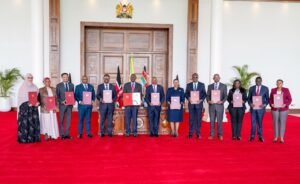


From colonial khaki to independence-era blue and the controversial deep blue outfit that made officers impossible to miss: the remarkable 119-year evolution of Kenya’s police uniform
It is the uniform that has announced the arrival of a Kenyan police officer for generations.
Now it is changing again.
But this time, the most striking feature is not the colour of the shirt or the cut of the trousers.
It is the fact that, for the first time in the history of Kenya’s police service, pregnant officers have been given a uniform designed specifically for them.
The new maternity outfit forms part of a sweeping overhaul of the Kenya Police uniform unveiled by President William Ruto at the Kenya Police Service Training College in Kiganjo, Nyeri County.

The plain light-blue maternity dress is designed to accommodate the changing body of an expectant officer while preserving the unmistakable appearance and authority of the police uniform.
It is a small change with a surprisingly large symbolic significance.
For more than a century, police uniforms in Kenya have been designed primarily around authority, discipline and visibility.
The latest reforms add another consideration: the welfare and practical needs of the officer wearing the uniform.
President Ruto said the new design followed consultations with police officers and members of the public in 2023, together with recommendations from the Presidential Task Force on Police Reforms.
“We are unveiling a new uniform for general duty officers of the Kenya Police Service. This change follows consultations with police officers and the public in 2023 as well as recommendations from the Presidential Task Force,” he said.
The change also marks the end of an experiment with an unmistakable deep-blue uniform.
Introduced in 2018 under President Uhuru Kenyatta, the predominantly Persian-blue outfit was intended to give the police a more unified and recognisable appearance following reforms within the National Police Service.
But there was a problem.
The blue was almost too successful at making police officers recognisable.
An officer in the deep-blue uniform could be spotted from a considerable distance, making the outfit highly conspicuous in public spaces.
Visibility is useful for routine policing — but officers also operate in situations where blending into their surroundings, approaching suspects without immediately advertising their presence and maintaining an element of tactical discretion can be important.
The colour also became a source of dissatisfaction among officers.
During subsequent consultations, complaints were raised about the uniform’s appearance, practicality and durability.
Some officers questioned the quality of the material, while others wanted a return to the more traditional light-blue shirt and dark-trouser combination that Kenyans had become accustomed to seeing.
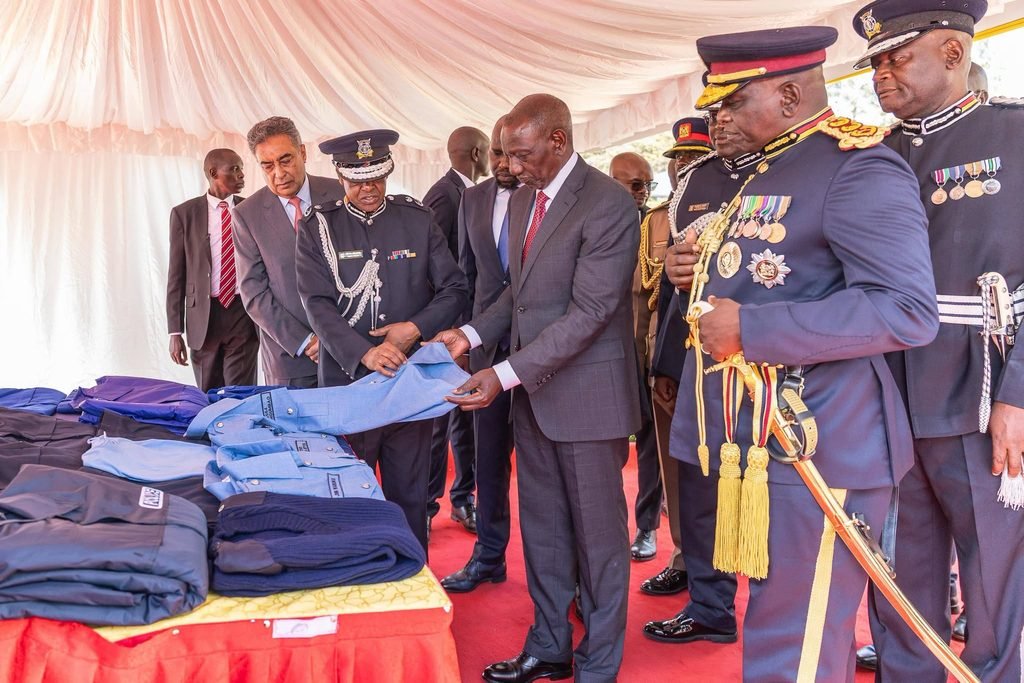
Inspector General of Police Douglas Kanja confirmed that the latest design is, in effect, a return to that earlier choice.
“We have been using the blue, the deep blue one, so we have just reverted back to the one that was agreed upon,” Kanja said.
The new General Duty uniform consists of a light-blue shirt and deep navy-blue trousers.
It also incorporates features intended to improve identification and accountability.
The Kenya Police emblem is placed on one sleeve and the Kenyan flag on the other, while officers’ names are permanently attached to the uniform.
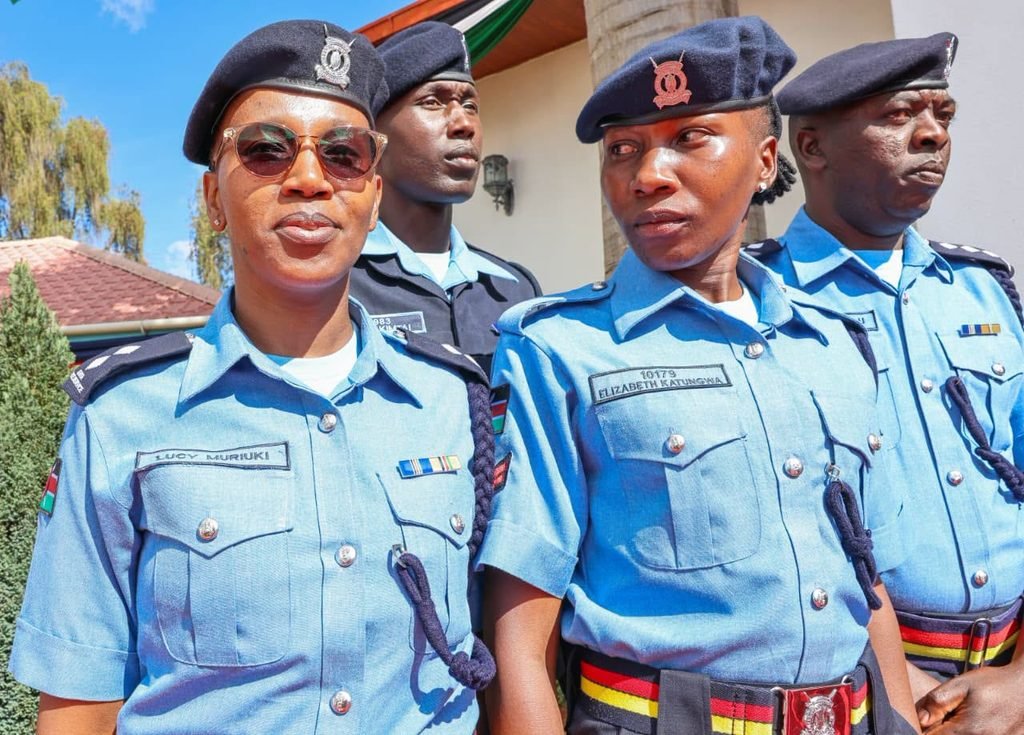
The changes are intended to make the officer more identifiable to members of the public and strengthen professional accountability.
The new collection also includes long- and short-sleeved shirts, sweaters, trench coats, rainwear and reflective clothing.
But the maternity dress is the feature likely to attract the most attention.
For years, pregnant officers had to work within a uniform system that was never specifically designed around pregnancy.
As their bodies changed, the conventional shirt, trousers and belt combination became increasingly difficult to wear comfortably.
The new maternity uniform effectively acknowledges something that has become impossible to ignore: women are no longer a peripheral presence in Kenya’s police service.
They patrol streets, investigate crimes, command units, work in specialised departments and occupy senior positions.
The uniform has had to catch up with the workforce.
From colonial khaki to the modern Kenyan police
The transformation becomes even more striking when viewed against the history of policing in Kenya.
The Kenya Police was established in 1907 during British colonial rule.
The force was modelled heavily on British policing traditions and operated within the hierarchical and racial structures of the colonial administration.
African police constables were commonly dressed in khaki-style uniforms, often featuring shorts, tunics and other military-influenced elements.
The uniform was designed to communicate authority — but that authority belonged to a colonial state.
The police uniform therefore became one of the most visible symbols of British rule.
Independence in 1963 changed the meaning of that uniform.
Kenya inherited the colonial policing institution, but its officers now represented an independent African state.
Over the following decades, the uniform evolved into the familiar Kenyan combination of a light-coloured shirt, dark trousers and distinctive headgear.
The appearance became deeply embedded in public memory.
For generations, the sight of a light-blue police shirt at a roadside checkpoint, outside a government building or directing traffic was instantly recognisable.
Then, in 2018, came the dramatic break.
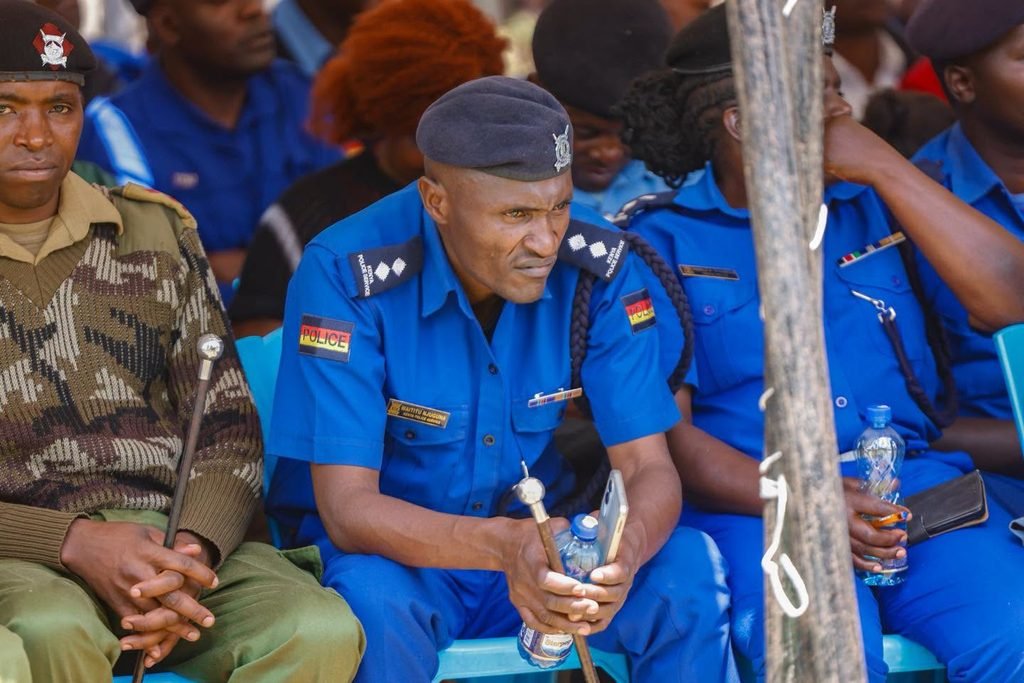
The traditional look was replaced by the all-Persian-blue outfit.
It was bold.
It was distinctive.
And it was difficult to miss.
The change was part of wider efforts to create a more unified National Police Service and establish a common identity following reforms involving the Kenya Police and Administration Police.
But what looked good on paper did not necessarily work for everyone on the ground.
By 2023, the service was once again asking officers and members of the public what they thought.
The answer was clear enough: bring back the light-blue shirt and dark trousers.
The latest uniform is therefore both new and familiar.
It is a reform — but also a return.
And officials believe the change will have consequences beyond appearances.
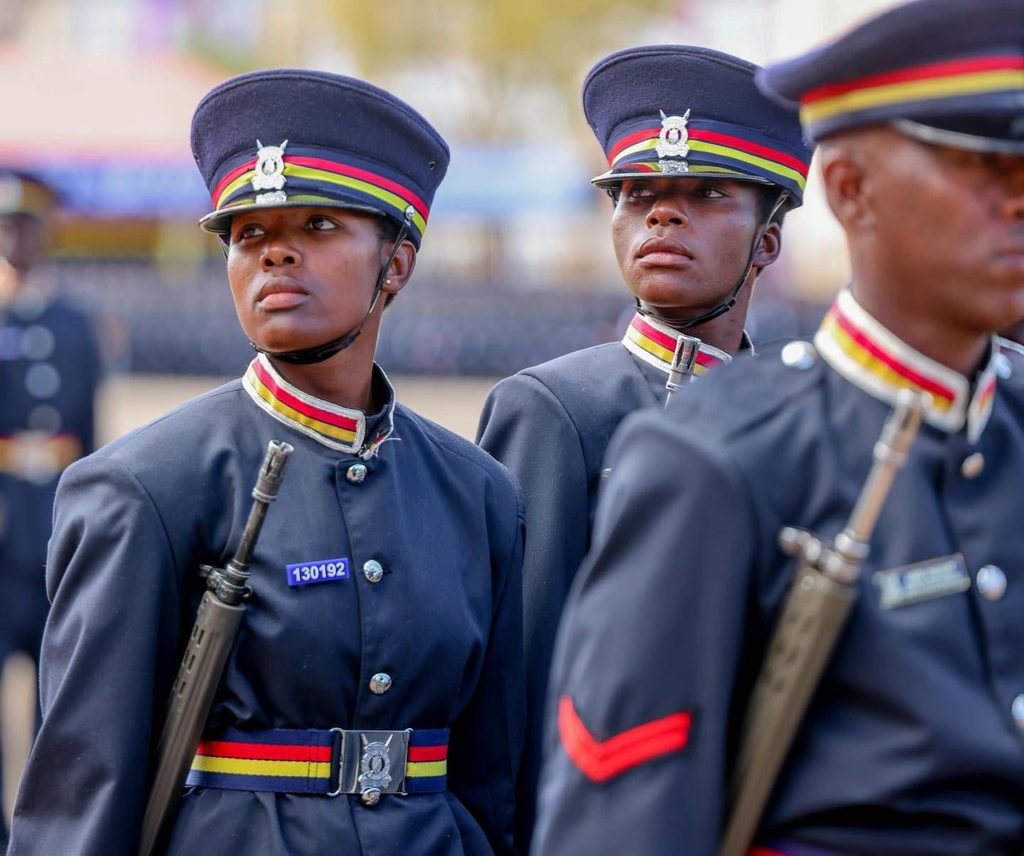
Kanja said the new uniform should boost the morale of officers, particularly those entering the service.
“This is also going to be a force multiplier in terms of morale boosting for our officers, especially the new recruits,” he said.
The new outfit will initially be worn by graduating recruits before being progressively rolled out to General Duty officers across the country.
Administration Police Service and General Service Unit officers will retain their existing uniforms.
The transformation of Kenya’s police uniform is therefore a story about much more than fashion.
The colonial khaki reflected an imperial hierarchy.
The post-independence uniform helped establish a national identity.
The 2018 deep-blue uniform emphasised visibility and institutional uniformity.
And the 2026 design is attempting to combine visibility with practicality, accountability and professionalism.
Most importantly, the maternity uniform signals that the modern police service is beginning to recognise the individual officer behind the badge.
After 119 years of evolution, Kenya’s police uniform is no longer simply telling the public who has authority.
It is also beginning to recognise who is/was wearing it.
Get facts, not noise. Follow Topnews.ke on WhatsApp for verified news updates and deep-dive explainers you can trust. https://whatsapp.com/channel/0029Vb7HscB7T8bNySqHXn3b


