
Kenya’s decision to front Njoki Ndung’u for a seat at the International Criminal Court reflects years of legal experience, judicial leadership, and her long-standing role in shaping Kenya’s constitutional and human rights framework.
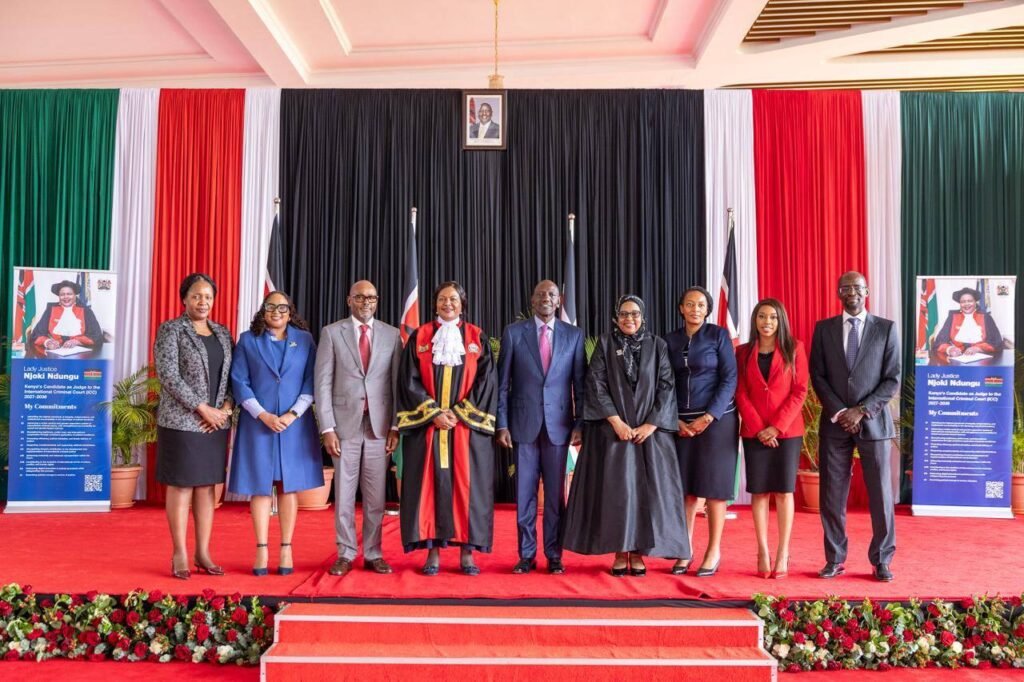
The Supreme Court judge was officially unveiled as Kenya’s candidate during a ceremony at State House Nairobi attended by top government officials, members of the Judiciary, diplomats, and legal experts.
President William Ruto described Ndung’u as a courageous and principled leader whose professional track record made her the ideal candidate for the global role.
“I have listened very carefully to the track record of Njoki Ndung’u and also listened to her vision at the ICC. They are persuasive, coherent and meaningful,” Ruto said.
Strong Background in Constitutional Law
Ndung’u is widely recognised as one of the legal experts who helped draft Kenya’s 2010 Constitution through the Committee of Experts process.
Her involvement in constitutional reform positioned her among the country’s most influential legal minds, particularly in areas touching on democracy, governance, accountability, and human rights.
Legal analysts say this experience gives her a strong foundation for handling complex international legal matters at the ICC, which deals with genocide, crimes against humanity, and war crimes.
Reputation for Courage and Judicial Independence
President Ruto and senior Judiciary officials praised Ndung’u for demonstrating independence and courage throughout her public service career.
“Njoki Ndung’u has been very courageous. She has not shied away when it was the right thing for her to do even if it was to stand alone,” Ruto said during the launch.
Her supporters argue that the ICC requires judges who can make difficult decisions under international pressure while remaining committed to justice and fairness.
Ndung’u has also built a reputation for advocating for vulnerable groups, women’s rights, and legal reforms throughout her legal career.
Africa’s Voice at the ICC
Kenya’s leadership says another key reason behind her nomination is the need for stronger African representation within international justice systems.
Chief Justice Martha Koome said Africa needed more voices capable of contributing judicial wisdom and perspectives shaped by constitutional transformation and post-conflict recovery.
Ndung’u herself emphasized that an African judge must bring African legal experiences into international jurisprudence.
“A judge from Africa must bring an African perspective,” she said.
She added that the ICC must continue rebuilding trust and cooperation with African states while ensuring fairness and accountability in global justice systems.
Decades of Public Service
Ndung’u has served on Kenya’s Supreme Court since its establishment and remains one of the country’s most recognised legal figures.
Her experience in legislative reform, constitutional interpretation, and judicial leadership has positioned her as one of Kenya’s strongest candidates for an international judicial role.
If elected, she would join the Hague-based court at a time when debates around international justice, accountability, and Africa’s role in global institutions continue to grow.


