
1. Basic Identity
Official name: County Government of Garissa
County code: 007
County headquarters: Garissa Town
Region: North Eastern Kenya
Area: Approximately 44,736 square kilometres
2019 population: 841,353 people
According to the Kenya National Bureau of Statistics (KNBS), Garissa had a population of 841,353 people in the 2019 Kenya Population and Housing Census. The county covers approximately 44,736 square kilometres, giving it a population density of about 19 people per square kilometre.
Garissa County is located in Kenya’s north-eastern region and borders Wajir County to the north, Isiolo County to the west, Tana River County to the south-west and Lamu County to the south. It also shares an international border with Somalia to the east.
The county is predominantly arid and semi-arid and forms part of Kenya’s wider ASAL region. Its economy and livelihoods are strongly influenced by pastoralism, livestock trade, agriculture along the Tana River, humanitarian activities, public services and commerce.
Garissa Town serves as the county headquarters and is the principal administrative, commercial and transport centre in north-eastern Kenya.
Other important towns and trading centres include Dadaab, Modogashe, Masalani, Hulugho, Balambala, Bura, Fafi and Liboi.
The county is particularly known for livestock production and trade, the Tana River ecosystem, the Dadaab refugee complex, wildlife conservation areas and its strategic location along routes connecting Kenya to Somalia and other parts of northern Kenya.
Garissa is also home to the Tana River, which provides an important source of water for agriculture, livestock, domestic use and ecological systems in a region where rainfall is highly variable.
The county’s economy is increasingly diversifying beyond traditional pastoralism, with opportunities in livestock value addition, agriculture, trade, renewable energy, tourism, fisheries, manufacturing and logistics
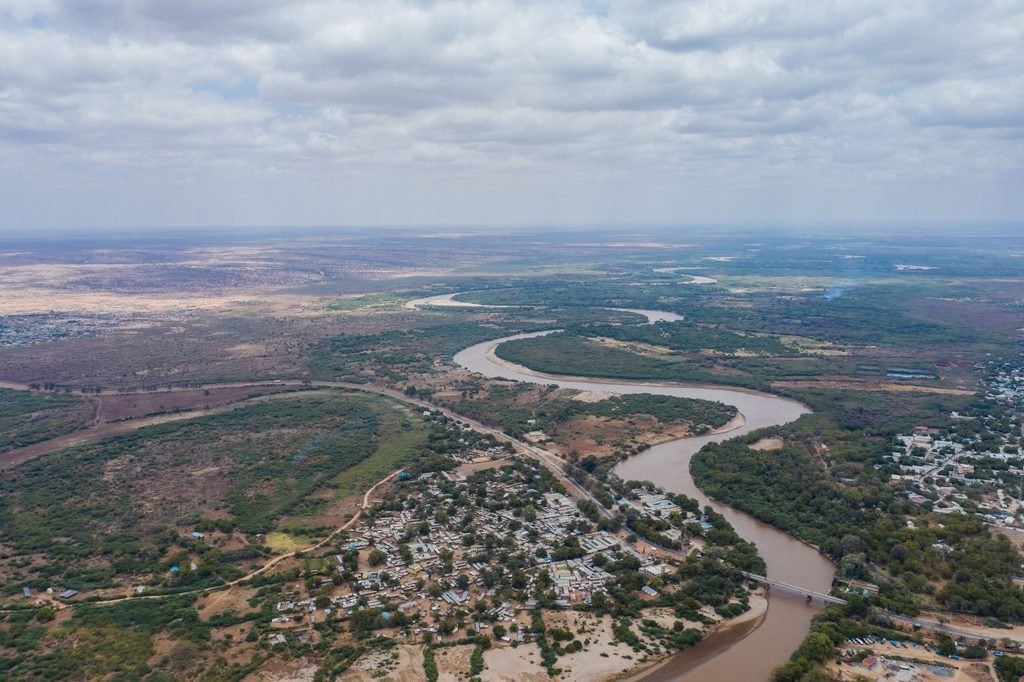
A view of Garissa County, highlighting its semi-arid landscape and growing urban centre along the Tana River.
2. Political and Administrative Structure
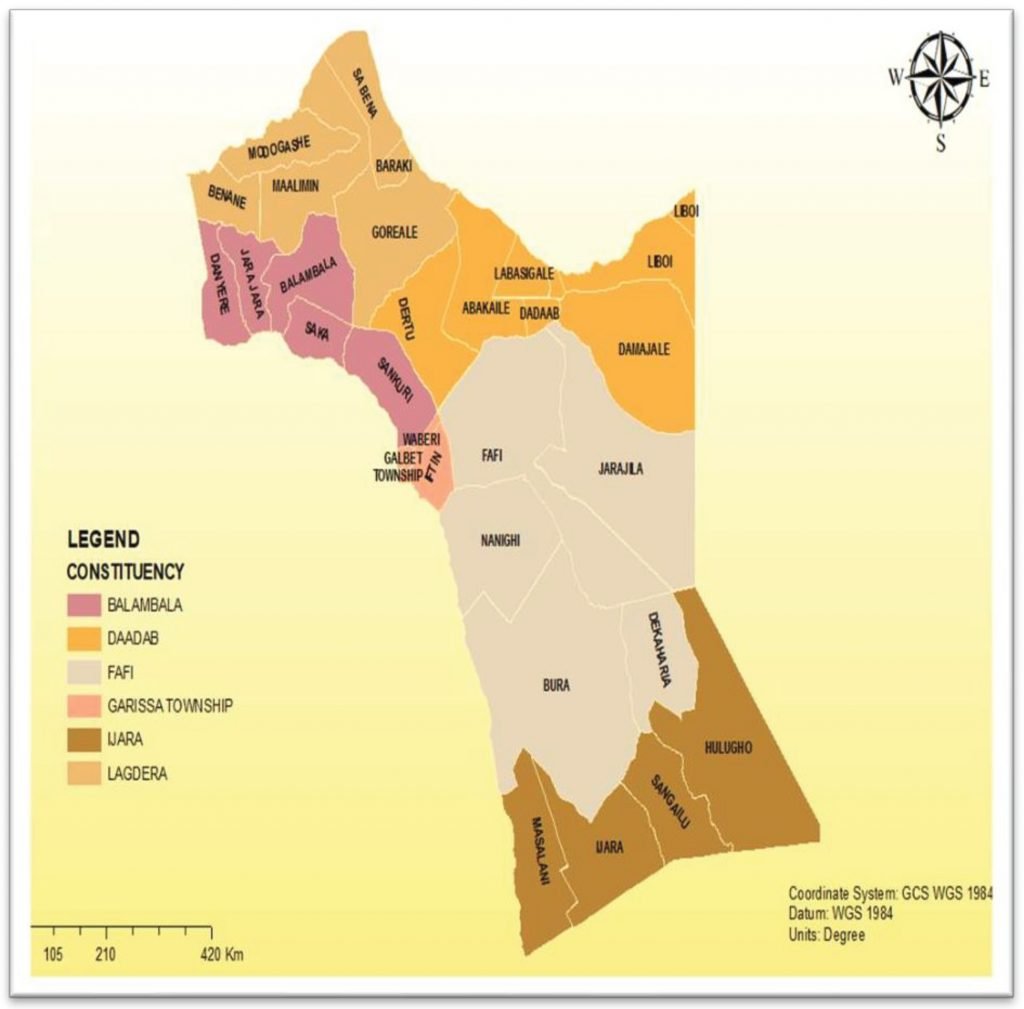
Garissa County has six parliamentary constituencies and 30 electoral wards. The county government is administratively divided into seven sub-counties.
The six constituencies are Garissa Township, Balambala, Lagdera, Dadaab, Fafi and Ijara.
The seven sub-counties are Garissa Township, Balambala, Lagdera, Dadaab, Fafi, Ijara and Hulugho.
A. Garissa Township Constituency – 4 Wards
- Waberi
- Galbet
- Township
- Iftin
B. Balambala Constituency – 5 Wards
- Balambala
- Danyere
- Jarajara
- Saka
- Sankuri
C. Lagdera Constituency – 6 Wards
- Modogashe
- Benane
- Goreale
- Maalimin
- Sabena
- Baraki
D. Dadaab Constituency – 6 Wards
- Dertu
- Dadaab
- Labasigale
- Damajale
- Liboi
- Abakaile
E. Fafi Constituency – 5 Wards
- Bura
- Dekaharia
- Jarajila
- Fafi
- Nanighi
F. Ijara Constituency – 4 Wards
- Hulugho
- Sangailu
- Ijara
- Masalani
The county therefore has a total of six constituencies and 30 electoral wards.
Administratively, Garissa County operates alongside national government structures responsible for security, national administration and other functions retained by the national government.
The county government is responsible for devolved functions including healthcare, agriculture, livestock development, water services, urban services, trade development, early childhood education and other functions assigned to counties under the Constitution.
Garissa’s administrative structure is shaped by its enormous geographical size and low population density. Delivering healthcare, water, education and other public services across widely dispersed settlements remains one of the county’s major development challenges.
3. Current Political Leadership
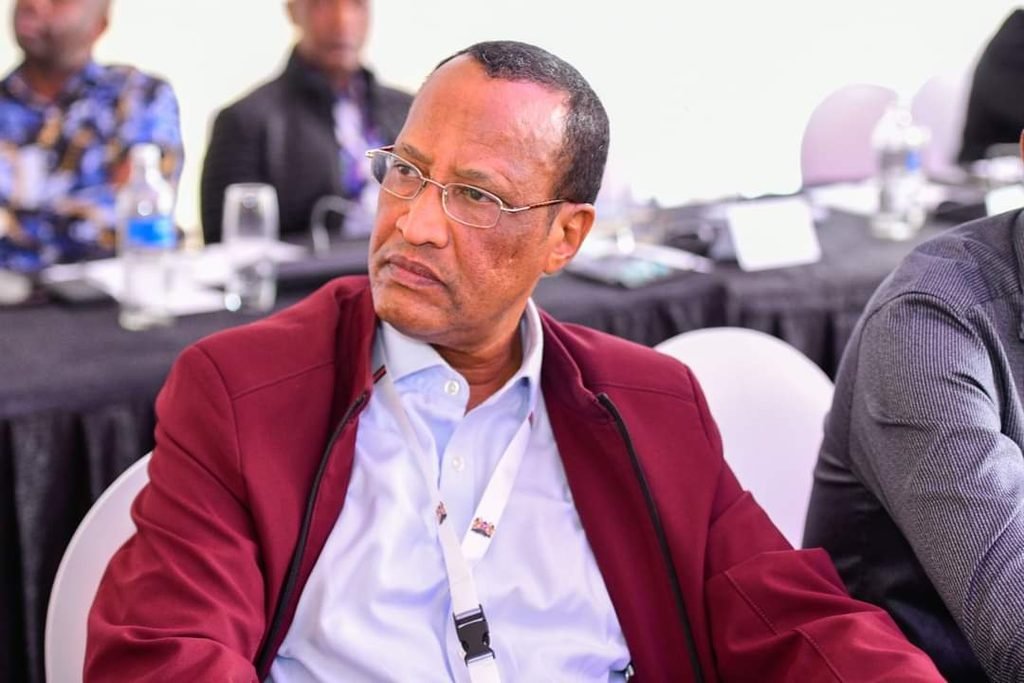
Garissa Governor Nathif Jama Adam
| Position | Office Holder |
|---|---|
| Governor | Hon. Nathif Jama Adam |
| Deputy Governor | Hon. Abdi Dagane Muhumed |
| Senator | Hon. Mohamed Yusuf Haji |
| Woman Representative | Hon. Amina Udgoon Siyad |
Nathif Jama Adam is the current governor of Garissa County. He returned to the governor’s office after winning the 2022 General Election, having previously served as governor between 2013 and 2017.
His administration has focused on areas including healthcare, water, livestock, agriculture, education, infrastructure, trade and economic empowerment.
The county government has also continued to work with development and humanitarian partners on resilience, livelihoods, nutrition, water, food security and drought response. Garissa’s partnership with organisations such as the World Food Programme reflects the importance of resilience and food-security programmes in the county.
Abdi Dagane Muhumed serves as deputy governor.
Senator Mohamed Yusuf Haji represents Garissa County in the Senate.
Amina Udgoon Siyad is the elected Woman Representative for Garissa County. Parliamentary records identify her as the Garissa County Woman Representative and show her participation in debates on issues affecting drought-affected communities in northern Kenya.
4. Members of Parliament
The current National Assembly representatives for Garissa’s six constituencies are:
| Constituency | Member of Parliament | Party |
|---|---|---|
| Garissa Township | Dekow Mohamed Barrow | UDA |
| Balambala | Abdi Omar Shurie | Jubilee Party |
| Lagdera | Mohamed Abdikadir Hussein | ODM |
| Dadaab | Farah Maalim | WDM-K |
| Fafi | Farah Salah Yakub | UDA |
| Ijara | Abdi Ali Abdi | NAP-K |
Parliament’s current records list Mohamed Abdikadir Hussein, Farah Salah Yakub, Farah Maalim and Abdi Ali Abdi among Garissa’s elected MPs, while parliamentary records also identify Abdi Omar Shurie as Balambala MP.
Garissa Township MP Dekow Mohamed Barrow was elected on a UDA ticket and has been active in parliamentary discussions involving security, refugees, host communities and development challenges in northern Kenya.
Political debates in Garissa frequently centre on drought, livestock, water, insecurity, roads, refugee-host community relations, education, healthcare, employment and equitable distribution of national resources.
The county’s political landscape also reflects the influence of national parties alongside local political networks and leaders.
5. Economy and Gross County Product
Garissa is one of Kenya’s important economies in the wider North Eastern region.
Its economy is strongly influenced by livestock production and trade, agriculture, wholesale and retail commerce, public administration, humanitarian operations, transport, construction and services.
According to the latest KNBS Gross County Product data, Garissa’s nominal Gross County Product increased from KSh 59.3 billion in 2020 to KSh 89.2 billion in 2024.
| Year | Gross County Product |
|---|---|
| 2020 | KSh 59.3 billion |
| 2021 | KSh 66.0 billion |
| 2022 | KSh 67.5 billion |
| 2023 | KSh 73.8 billion |
| 2024 | KSh 89.2 billion |
Source: KNBS Gross County Product 2025.
Garissa’s economy remains relatively small compared with Kenya’s major urban and industrial counties, but its strategic importance extends beyond its GCP because it serves as a commercial and administrative hub for a large part of northern Kenya.
The Economic Structure
Garissa’s economy rests on several major pillars:
- Livestock and pastoralism
- Agriculture
- Livestock trade and markets
- Wholesale and retail trade
- Transport and logistics
- Construction
- Public administration
- Humanitarian and development services
- Financial and business services
- Renewable energy
- Fishing and aquaculture
- Tourism and conservation
The county’s economic prospects are closely connected to the ability to increase productivity and value addition in livestock and agriculture while improving water, roads, electricity and market infrastructure.
6. Agriculture: A Growing Economic Opportunity
Agriculture in Garissa is concentrated particularly around areas benefiting from the Tana River and irrigation infrastructure.
The river provides an important agricultural corridor in an otherwise dry county.
Major crops and agricultural activities include:
- Maize
- Rice
- Fruits
- Vegetables
- Watermelons
- Bananas
- Cowpeas
- Sorghum
- Horticultural crops
Irrigated agriculture has become increasingly important because it allows farmers to produce crops despite the county’s generally low and unreliable rainfall.
The Tana River provides opportunities for expanding irrigation, horticulture, fruit production and agro-processing.
Major Agricultural Activities
- Irrigated farming
- Horticulture
- Fruit production
- Rice farming
- Vegetable production
- Watermelon farming
- Livestock fodder production
- Agro-processing
Agriculture nevertheless faces challenges including drought, high production costs, inadequate irrigation infrastructure, pests and diseases, limited access to markets and post-harvest losses.
Climate change has also increased pressure on agricultural systems, with prolonged dry periods and unpredictable rainfall affecting both crop production and livestock.
The expansion of irrigation and investment in climate-smart agriculture could significantly increase Garissa’s food production and create employment opportunities.
7. Livestock and Fisheries
Livestock
Livestock keeping is the backbone of Garissa’s rural economy.
The county’s predominantly pastoral communities depend heavily on livestock for food, income, employment and social livelihoods.
Major livestock enterprises include:
- Cattle
- Goats
- Sheep
- Camels
- Donkeys
- Poultry
Camels are particularly well suited to Garissa’s dry environment and provide milk, meat and other products.
Livestock markets in Garissa connect pastoral producers with traders from other parts of Kenya and neighbouring countries.
The county has significant potential to expand livestock value chains through:
- Modern livestock markets
- Meat processing
- Milk processing
- Leather production
- Animal-feed production
- Cold-chain infrastructure
- Veterinary services
Drought remains the greatest threat to pastoral livelihoods.
Repeated droughts can result in livestock deaths, loss of household income, food insecurity and increased dependence on humanitarian assistance.
Fisheries and the Blue Economy
The Tana River also gives Garissa opportunities in fisheries and aquaculture.
Fishing activities along the river provide food and income to communities living near the water system.
The county has potential to expand aquaculture, fish processing, cold storage and commercial fish marketing.
Water availability, however, remains a major constraint to the expansion of fisheries and other water-dependent enterprises.
8. Key Industries
Garissa’s industrial sector remains smaller than those of Kenya’s major urban counties, but the county has significant opportunities for industrialisation.
Major Industries Include
- Livestock and meat processing
- Dairy processing
- Leather and hides
- Agro-processing
- Construction
- Retail and wholesale
- Transport and logistics
- Renewable energy
- Fishing and aquaculture
- Financial services
- Hospitality
- Small-scale manufacturing
Livestock Industry
The livestock economy provides the strongest foundation for industrial development.
Investment in abattoirs, meat-processing plants, leather production and cold-chain systems could allow Garissa to capture more value from livestock before animals and products leave the county.
Trade and Commerce
Garissa Town is one of the most important commercial centres in northern Kenya.
Its businesses serve residents from Garissa as well as traders and communities from neighbouring counties and across the Kenya-Somalia border.
Wholesale and retail trade therefore provide employment for thousands of residents.
Renewable Energy
Garissa’s high solar potential makes renewable energy another area of economic opportunity.
Solar energy can support households, businesses, irrigation, cold storage, water pumping and other economic activities in communities that remain distant from reliable grid electricity.
9. Population
The 2019 Kenya Population and Housing Census recorded Garissa County’s population at 841,353 people.
| Category | Population |
|---|---|
| Male | 458,975 |
| Female | 382,370 |
| Intersex | 8 |
| Total | 841,353 |
Source: KNBS, 2019 Kenya Population and Housing Census.
Garissa’s population is projected to have grown significantly since the 2019 census. County planning projections put the population at about 970,917 people in 2025.
Population distribution varies significantly across the county.
Garissa Township has a relatively high concentration of residents because of its urban and commercial role, while Dadaab has also recorded high population numbers partly because of the refugee population.
The county’s 2025 planning documents projected approximately 189,156 people in the Township sub-county and 213,780 in Dadaab.
Garissa’s population is predominantly youthful, creating opportunities for economic growth but also increasing pressure on:
- Employment
- Education
- Healthcare
- Housing
- Water
- Skills development
- Social services
Rapid population growth also increases demand for urban infrastructure in Garissa Town and other growing settlements.
10. Education and School Enrolment
Education remains a major development priority in Garissa County.
The county government is responsible for Early Childhood Development Education and vocational training, while primary and secondary education fall largely under the national government.
Education priorities include:
- Expansion of ECDE centres
- Classroom construction
- Learning materials
- Vocational training
- Scholarships and bursaries
- Support for vulnerable learners
- Digital learning
- Skills development
The county faces significant education challenges linked to poverty, drought, long distances between settlements, insecurity and inadequate infrastructure.
Pastoralist lifestyles can also affect school attendance where families move in search of pasture and water.
Higher Education
Garissa has increasingly developed into an education and training centre for northern Kenya.
Major institutions include:
- Garissa University
- Garissa Teachers Training College
- Kenya Medical Training College – Garissa
- Technical and vocational education institutions
- Various private colleges
Garissa University is particularly important to the county’s higher education and skills-development ecosystem.
Technical and vocational training also offers an important pathway for young people seeking practical skills in construction, ICT, mechanics, agriculture, business and other sectors.
11. Health Infrastructure
Garissa has a network of public and private health facilities serving communities across its seven sub-counties.
The county health system includes a referral hospital, sub-county hospitals, health centres, dispensaries and private facilities.
Major Referral Hospital
Garissa County Referral Hospital
Garissa County Referral Hospital is the county’s main public referral facility and provides general and specialised healthcare services to residents.
Its services include:
- Emergency care
- Maternity services
- Surgery
- Paediatric care
- Diagnostic services
- Outpatient services
- Maternal and child healthcare
- Specialist services
Major Public Health Facilities
- Garissa County Referral Hospital
- Balambala Sub-County Hospital
- Dadaab Sub-County Hospital
- Fafi health facilities
- Ijara Sub-County Hospital
- Lagdera health facilities
- Hulugho health facilities
- Garissa Township health facilities
Healthcare delivery remains challenging because of the county’s huge geographical size and dispersed settlements.
Major challenges include:
- Shortages of healthcare workers
- Limited specialist services
- Medical supply gaps
- Maternal and child health challenges
- Malnutrition
- Drought-related health risks
- Long distances to health facilities
- Inadequate health infrastructure
The county’s health system also works closely with humanitarian and development organisations because of the region’s vulnerability to drought, food insecurity and displacement.
12. Dadaab and the Refugee Economy
Dadaab gives Garissa a unique position within Kenya’s humanitarian and refugee landscape.
The Dadaab refugee complex has hosted refugees from Somalia for decades and has become one of the world’s best-known refugee settlements.
The presence of refugees has created both economic opportunities and significant pressure on local resources.
Humanitarian organisations operating in and around Dadaab support sectors including:
- Food security
- Healthcare
- Education
- Water and sanitation
- Livelihoods
- Protection
- Nutrition
- Emergency response
Host communities have repeatedly raised concerns over pressure on water, land, infrastructure, employment opportunities and natural resources.
At the same time, refugee settlements have generated markets for local traders, transport operators, food suppliers, construction businesses and service providers.
The debate over refugee integration and the future of Dadaab has therefore become an important political and economic issue for Garissa.
Parliamentary discussions have highlighted concerns from both national leaders and local representatives about balancing the needs of refugees with those of host communities.
13. Environment, Water and Climate Challenges
Garissa is one of Kenya’s counties most exposed to climate variability.
The county experiences frequent droughts, while floods along the Tana River can also affect communities during periods of heavy rainfall.
9. Tourism Sector
Garissa’s tourism industry is smaller than that of Kenya’s coastal and wildlife-rich counties, but the county possesses distinctive wildlife, cultural and ecological tourism opportunities.
Major tourism attractions
Bour-Algi Giraffe Sanctuary
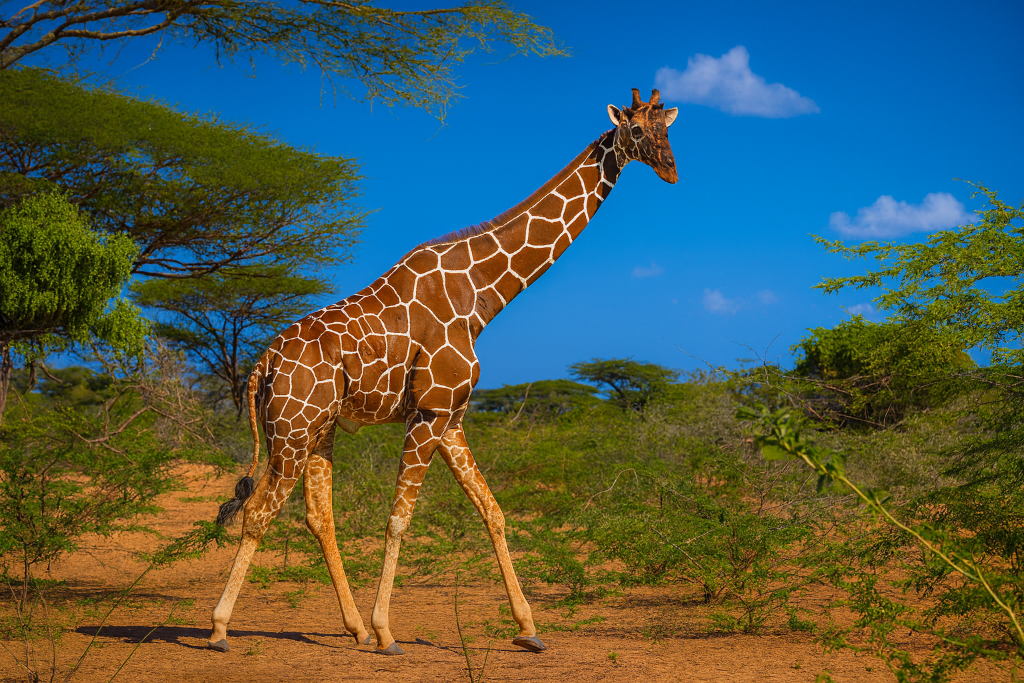
Located near Garissa Town, the Bour-Algi area provides habitat for the endangered Rothschild’s giraffe, alongside other wildlife species. The sanctuary is one of the county’s most important wildlife attractions.
Tana River ecosystem
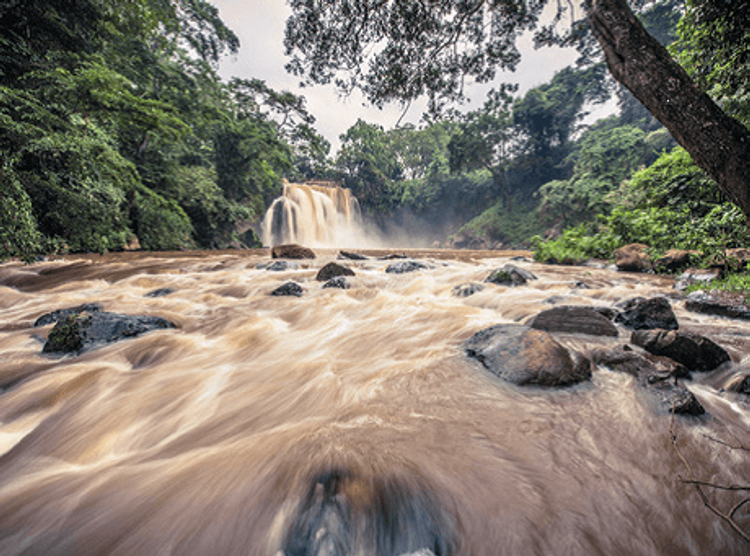
The Tana River provides opportunities for nature tourism, birdwatching, fishing and river-based recreation. Its green riverine landscape contrasts sharply with the surrounding arid environment.
Pastoral and cultural tourism
Garissa’s pastoral traditions provide opportunities for cultural tourism centred on livestock markets, traditional food, Somali architecture, crafts, poetry and community heritage.
Dadaab
The Dadaab area has international significance because of its long history as a major refugee-hosting centre. Although refugee camps are primarily humanitarian facilities rather than conventional tourist attractions, the area forms an important part of Garissa’s modern social history.
Major Environmental Challenges
- Drought
- Desertification
- Land degradation
- Water scarcity
- Flooding
- Loss of vegetation
- Human-wildlife conflict
- Overgrazing
- Climate change
Water is one of Garissa’s most important development issues.
The Tana River provides a critical water resource, but many communities away from the river remain dependent on boreholes, water pans and other sources.
The county’s large geographical area makes water infrastructure expensive to develop and maintain.
Investment in water harvesting, boreholes, irrigation, dams and climate-resilient infrastructure is therefore central to Garissa’s development.
14. History of County Political Leadership
Garissa has been one of the most politically significant counties in northern Kenya since the establishment of devolved governments under the 2010 Constitution.
The county has produced influential national political figures and has played an important role in national debates involving pastoralist communities, security, devolution, refugees and development in northern Kenya.
Governors
1. H.E. Nathif Jama Adam (2013–2017)
Nathif Jama Adam became Garissa’s first governor following the 2013 General Election.
His first administration focused on establishing the county government and expanding devolved services in healthcare, water, education, livestock and infrastructure.
He returned to the governor’s office after winning the 2022 election and remains in office.
2. H.E. Ali Korane (2017–2022)
Ali Korane served as governor of Garissa from 2017 to 2022.
His administration focused on infrastructure, water, healthcare, agriculture, livestock development and other county services.
3. H.E. Nathif Jama Adam (2022–Present)
Nathif Jama Adam returned to office after winning the 2022 General Election.
His second administration has prioritised:
- Healthcare
- Water
- Livestock
- Agriculture
- Education
- Infrastructure
- Trade
- Youth empowerment
- Climate resilience
The county has also continued to engage development partners on drought response, food security, resilience and livelihood programmes.
Political Significance
Garissa’s political debates are closely linked to:
- Drought
- Livestock
- Water
- Security
- Refugees
- Land
- Education
- Healthcare
- Youth employment
- Infrastructure
- Pastoralist livelihoods
- Equitable development
The county also has a strong history of producing national political leaders.
15. Key Personalities Associated with Garissa
Garissa has produced influential figures in politics, public service, business, humanitarian work and community leadership.
Politics and Governance
Nathif Jama Adam
Nathif Jama Adam is the current governor of Garissa and the county’s first governor after devolution. He has served two non-consecutive terms.
Aden Duale
Aden Duale is one of the most prominent politicians associated with Garissa.
He represented Garissa Township in Parliament for several terms and served as Majority Leader of the National Assembly. He later served in the national government.
Mohamed Yusuf Haji
Mohamed Yusuf Haji was a prominent Kenyan politician and public servant who represented Garissa in the Senate and previously served as a Member of Parliament and Cabinet minister.
His political career was closely associated with security, national government and the development of northern Kenya.
Farah Maalim
Farah Maalim is a veteran politician who has represented Dadaab Constituency and has held senior positions in Parliament.
His political career has included senior parliamentary leadership and extensive involvement in national and regional political debates.
Humanitarian and Community Leadership
Garissa’s position along the Kenya-Somalia border and its hosting of the Dadaab refugee complex have also produced a large network of humanitarian workers, community organisers and development leaders.
The county has become an important centre for humanitarian operations addressing drought, displacement, food insecurity, healthcare, education and livelihoods.
Garissa’s Cultural Identity
Garissa’s identity is strongly connected to Somali culture, pastoralism, trade and its position along historic commercial routes linking northern Kenya and Somalia.
Traditional livestock markets, Islamic heritage, Somali cuisine, poetry and oral traditions form important elements of the county’s cultural identity.
16. Garissa County at a Glance
Garissa is one of Kenya’s largest counties by land area and one of the country’s most important centres in the north-eastern region.
Its economic identity rests on several major pillars:
- Livestock and pastoralism
- Agriculture
- Trade and commerce
- Humanitarian and development services
- Transport and logistics
- Public administration
- Renewable energy
- Fisheries and aquaculture
The county’s 44,736-square-kilometre territory contains widely dispersed communities, making the delivery of public services particularly challenging.
Livestock remains central to the local economy, with cattle, goats, sheep and camels supporting household incomes.
The Tana River creates opportunities for irrigation, agriculture, fisheries and water-based economic activities.
Garissa Town is the county’s principal commercial and administrative centre, while Dadaab has an important humanitarian and refugee-related economy.
The county’s biggest development challenges include drought, water scarcity, poverty, unemployment, inadequate infrastructure, insecurity, climate change, limited industrialisation and pressure on public services.
At the same time, Garissa has significant untapped economic potential.
Investment in livestock value addition, irrigation, agro-processing, renewable energy, water infrastructure, transport, trade and tourism could strengthen the county’s economy and create employment for its growing youthful population.
The county’s strategic position bordering Somalia also gives it potential to become a major cross-border trade and logistics hub.
Garissa therefore represents a distinctive combination of pastoralism, agriculture, trade, humanitarian activity and emerging urban development.
Its future economic transformation will depend largely on how effectively the county and national governments address water scarcity, climate vulnerability, infrastructure deficits and youth unemployment while unlocking the value of livestock, agriculture and cross-border commerce.
17. References
- Kenya National Bureau of Statistics (KNBS). 2019 Kenya Population and Housing Census. Nairobi: KNBS.
- Kenya National Bureau of Statistics (KNBS). 2024 County Statistical Abstract – Garissa County.
- Kenya National Bureau of Statistics (KNBS). Gross County Product 2025.
- County Government of Garissa. County Integrated Development Plan 2023–2027.
- County Government of Garissa. Annual Development Plan 2025/2026.
- County Government of Garissa. County Annual Development Plan 2026/2027.
- County Government of Garissa. Garissa County Statistical Abstract 2024.
- Parliament of Kenya. Members of the National Assembly – 13th Parliament.
- Parliament of Kenya. National Assembly parliamentary records and member profiles.
- National Government Constituencies Development Fund (NG-CDF). Garissa County constituencies.
- Council of Governors / Maarifa Centre. Garissa County information and development documents.
- Kenya National Bureau of Statistics. County Statistical Abstracts.
- Garissa County Assembly. Garissa County political and administrative information.
- Parliament of Kenya. Hansard records on Garissa, drought, refugees and development in northern Kenya.
- Kenya Development Response to Displacement Impacts Project. Garissa operation areas and wards.
- County Government of Garissa. Development and resilience programmes.


